Jesus’ “Sermon on the Mount”. . . Matthew 5:17–20
“The Fulfillment of the Law”
In this section of his Sermon on the Mount, Jesus explains his relationship to the Law and the Prophets, assuring his listeners that he hasn’t come to abolish God’s Word but to bring it to its intended fulfillment. Here, he calls his disciples to a righteousness that goes beyond outward rule-keeping — a heart-deep obedience shaped by God’s will and fulfilled in Christ.
In Matthew 5:17–20, Jesus calls both his first listeners and us as readers today to recognize a crucial contrast: mechanical conformity to the letter of the law versus inward alignment with its divine intent.
Jesus offers a bold vision of doing right that’s grounded in God’s wisdom. Learn how this vision fulfills the teachings of the Torah. Here you can watch an exceptional video clip from BibleProject titled “Jesus Fulfills the Law” (6 minutes).
This contrast permeates the entire four-verse passage. It functions as a key for understanding the rest of the Sermon on the Mount and much of Jesus’ broader ministry. In vv. 17–20, Jesus contrasts his mission and kingdom standard with the dominant religious model of his day:
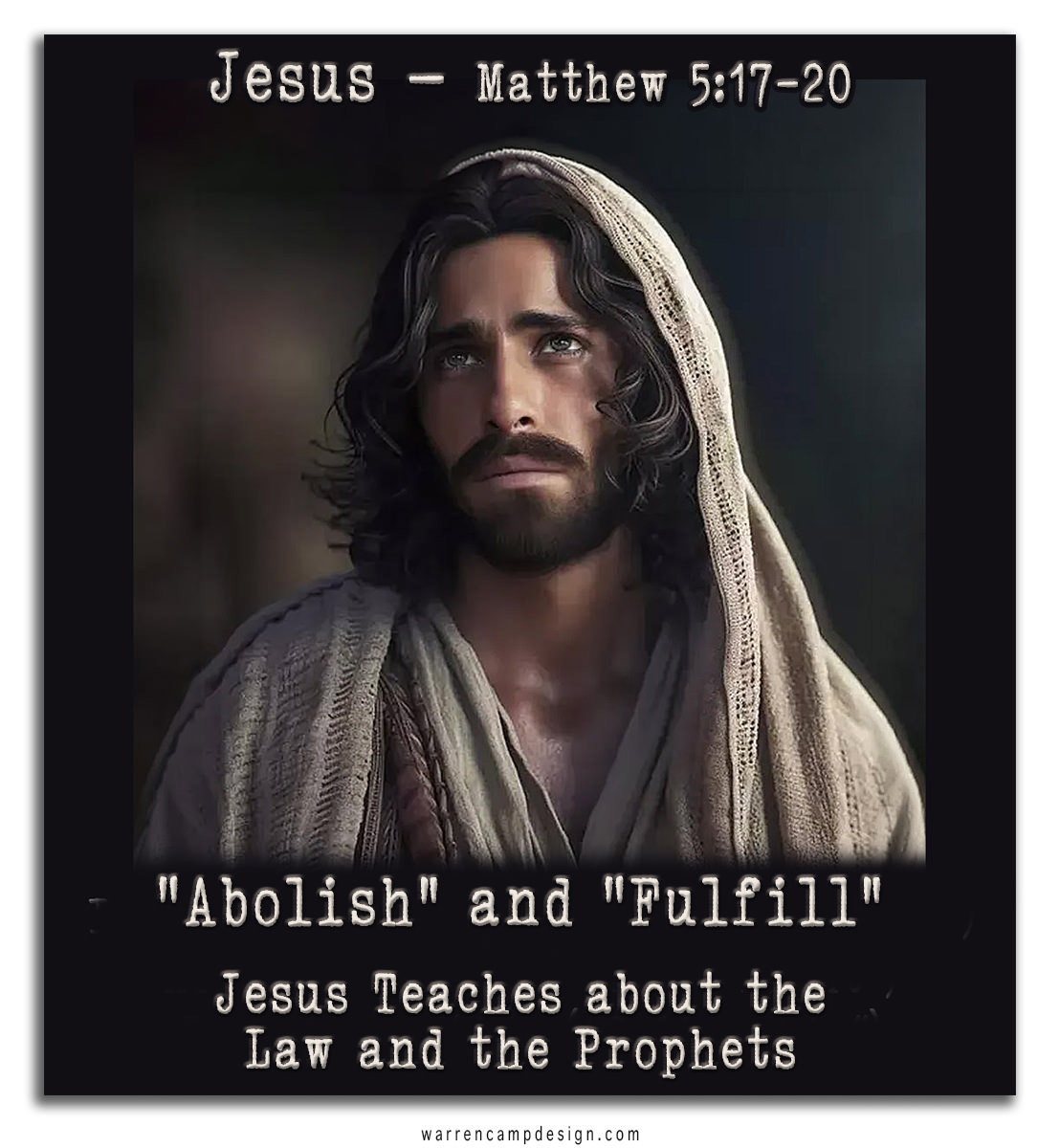
Click to enlarge and print:
Jesus teaching
“Abolish v. Fulfill.”
Verses 17–18 — Fulfillment rather than destruction: Jesus states that he came to fulfill the Law and the Prophets. To fulfill them means bringing their true intent, full weight, and ultimate goal to completion — something external compliance alone could never achieve.
Verse 19 — Faithful practice and teaching: Jesus warns against setting aside even what people may regard as a “least” command and teaching others to do likewise. Faithfully practicing and teaching God’s commands reflects a deeper, wholehearted obedience.
Verse 20 — The climax: Jesus declares that entrance into the kingdom requires righteousness exceeding that of the scribes and Pharisees. Because they were known for detailed outward rule-keeping, Jesus calls for a righteousness that differs not merely in quantity but in kind — a righteousness of inward devotion rather than external performance.
Where the scribes and Pharisees often emphasized visible compliance, meticulous rule-following, and outward religious performance, Jesus calls for hearts transformed to love, obey, and embody the underlying purpose of God’s law.
-
Pharisaical Righteousness: Focuses primarily on outward performance, treating obedience as a measurable standard to satisfy.
-
Kingdom Righteousness: Focuses on inward character, where God’s law is “written on the heart,” fulfilling God’s new-covenant promise (read Jer. 31:33b; enlarge image). It produces a deeper obedience that exceeds mere obligation because it flows from genuine devotion and love.

Jesus isn’t replacing the Law or lowering its standard. He fulfills it and reveals that true righteousness isn’t measured merely by how successfully one avoids outward violations, but by a heart increasingly transformed to do God’s will.
Note: This theme expands significantly throughout the remainder of Matthew’s gospel, especially in the coming commentaries on Matthew 5:21–48 and 6:1–18.
Jesus’ Mission: Fulfilling God’s Law and Promise (5:17)
“Do not think that I have come to abolish the Law or the Prophets; I have not come to abolish them but to fulfill them” (v. 17, NIV).
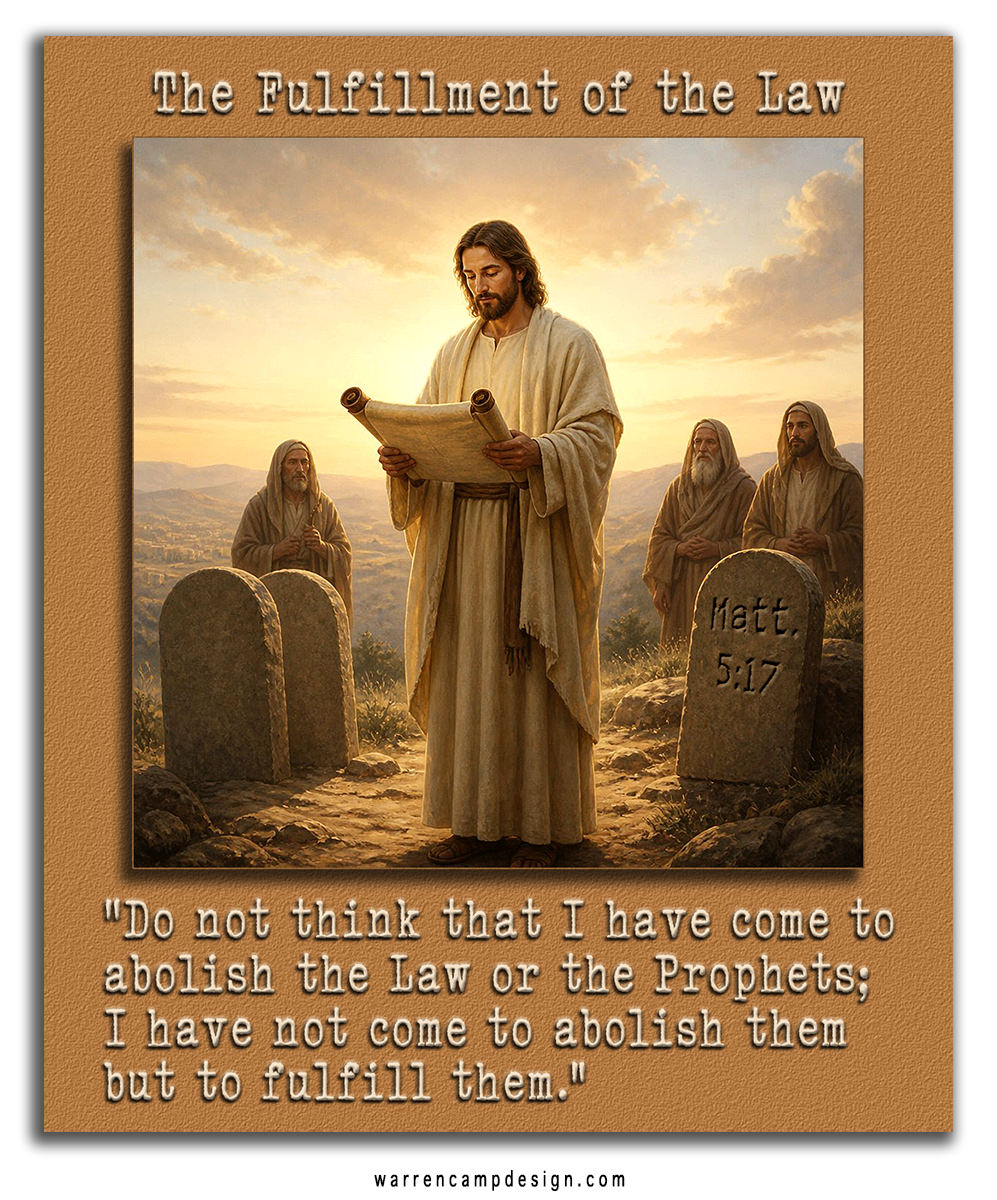
Jesus begins by correcting a possible misunderstanding about his mission. He hasn’t come to abolish — that is, to destroy, cancel, or invalidate — the Law and the Prophets. This phrase refers broadly to the Hebrew Scriptures, what Christians commonly call the Old Testament. Jesus doesn’t present his teaching as a rejection of what God had already revealed.
Instead, he’s come to fulfill them. To fulfill means to bring them to their intended goal and completion. The Law and the Prophets pointed forward to the coming Messiah, the arrival of God’s kingdom, and the righteousness God desires from his people. Jesus fulfills them through his life, teaching, obedience, sacrificial death, resurrection, and establishment of the promised kingdom.
Jesus therefore doesn’t set aside the Old Testament; he reveals its fullest meaning. He embodies the righteousness it teaches, completes the promises and prophecies it contains, and exposes interpretations that reduce God’s commands to outward performance. The Law’s divine purpose isn’t merely to regulate behavior but to form a people whose hearts, motives, and actions reflect love for God and others.
Application message: Verse 17 challenges us to resist two opposite errors. We mustn’t treat God’s earlier revelation as irrelevant. Nor should we approach it as a mechanical checklist that can be mastered through external performance. As followers of Jesus, we read the Law and the Prophets through him, trust him as their fulfillment, and seek to live out their God-centered purpose through the transforming power of his grace.
The Enduring Authority of the Law (5:18)
“For truly I tell you, until heaven and earth disappear, not the smallest letter, not the least stroke of a pen, will by any means disappear from the Law until everything is accomplished” (v. 18, NIV).
Watch BibleProject’s superb video about
Jesus’ Fulfillment Mission (6 min.).
Jesus reinforces his declaration from v. 17 by emphasizing the enduring authority of the Law. He assures his listeners that, until heaven and earth pass away, not even the smallest letter or least stroke of a pen will disappear from the Law before everything God intends to accomplish has been completed.
The references to the “smallest letter” and the “least stroke” express the greatest degree of precision possible. Jesus affirms that God’s revealed Word is trustworthy and that none of its divine purpose will fail. His statement isn’t an invitation to legalistic attention to isolated details; rather, it assures us that God’s revelation is authoritative in its entirety.
The phrase “until all is accomplished” points to the completion of God’s redemptive plan. Jesus himself is the fulfillment toward which the Law — also known as the Torah — and the Prophets pointed. Therefore, Christians don’t treat the Old Testament as irrelevant; neither do they read it as though Jesus hadn’t come. We read it through him, recognizing how its promises, patterns, and commands find their intended fulfillment in his person, teaching, saving work, and kingdom.
This verse also guards us against two opposite errors. We mustn’t dismiss the Law as obsolete or unimportant. Nor should we use it as a mechanical checklist for earning God’s acceptance. Jesus preserves its authority while revealing its true purpose: to lead people toward faithfulness to God, love for others, and the heart-deep righteousness developed throughout the remainder of Matthew 5.
Application message: Verse 18 calls us to approach Scripture with reverence, confidence, and obedient attention. We shouldn’t select only the passages that affirm our preferences; nor should we reduce God’s commands to outward actions. Instead, we should ask how Jesus reveals the Law’s fullest meaning and how its divine purpose should shape our motives, relationships, decisions, and daily conduct.
God’s Word won’t fail — not in its smallest detail, not in its greatest promise, and not in the purpose for which he gave it. Because Jesus fulfills the Law rather than abolishes it, we who are disciples of his should treat God’s Word as enduring truth, seeking to obey its divine intent with transformed hearts.
Practicing and Teaching God’s Commands (5:19)
The title I gave this verse’s subhead reflects the two essential verbs in v. 19: Disciples are to do or practice God’s commands and faithfully teach them to others. Jesus warns against setting aside even what people may consider a “least” command, especially when one’s relaxed obedience becomes instruction for others.
“Therefore anyone who sets aside one of the least of these commands and teaches others accordingly will be called least in the kingdom of heaven, but whoever practices and teaches these commands will be called great in the kingdom of heaven” (v. 19, NIV).
Because the Law won’t pass away before God’s purposes are accomplished, Jesus now applies that truth personally. He warns against treating any of God’s commands as insignificant, optional, or disposable. To “set aside” a command isn’t merely to fail in an isolated moment; it’s to loosen, nullify, or dismiss God’s instruction and then encourage others to regard it the same way.
Jesus joins practice and teaching. His disciples mustn’t be content merely to explain God’s will to others; they’re called to live it. Nor should they regard private obedience as sufficient when they have responsibility to help others understand God’s Word. The faithful kingdom citizen actively and intentionally does and teaches, allowing conduct and instruction to agree.
The phrase “least in the kingdom of heaven” is interpreted differently among Christians. Some understand it as a statement about lesser honor within the kingdom, while others understand it as a warning that false teachers who set aside God’s commands show that they don’t truly belong to the kingdom. Rather than forcing the verse to settle every question about future status, its immediate warning is clear: Jesus takes seriously the way his people handle God’s Word, both personally and publicly.
Conversely, the one who practices and teaches “these commands” will be called “great in the kingdom of heaven.” Greatness in Jesus’ kingdom isn’t measured by influence, titles, public recognition, or religious achievement. It’s measured by humble, faithful obedience that points others toward God’s will.
Application message: Verse 19 invites us to examine the integrity of our discipleship. Do we quietly disregard the parts of Scripture that challenge our habits, preferences, or relationships? If we teach God’s Word, do our actions support—or contradict—our instruction? Kingdom greatness isn’t found in knowing God’s commands alone, nor in teaching them eloquently. It’s found in humbly practicing them and helping others do the same.
A helpful bridge to v. 20 is this: The superior righteousness Jesus requires isn’t achieved by adding more outward rules; it grows from the new-covenant work God promised through Jeremiah, writing his law upon the minds and hearts of his people (Jer. 31:33b).
The Righteousness That Comes from Within (5:20)
When Jesus told his followers that their righteousness had to surpass that of the most religious people of their day, he wasn’t merely raising the bar of rule-keeping; he was completely redefining what true righteousness means. His words must have startled his listeners. The scribes were experts in interpreting the Law, and the Pharisees were widely known for their careful religious observance.
“For I tell you that unless your righteousness surpasses that of the Pharisees and the teachers of the law, you will certainly not enter the kingdom of heaven” (v. 20, NIV).
While the Pharisees were masters of managing their behavior on the outside, the righteousness they promoted fell short because it left the human heart unchanged on the inside. Jesus didn’t deny the value of obedience to God’s commands. Rather, he exposed the insufficiency of an obedience that’s visible in public but doesn’t flow from love for God, humility, mercy, and a transformed heart.
The righteousness of God’s kingdom reaches deeper than actions alone. It includes our motives, desires, words, attitudes, and treatment of others. In the verses that follow, Jesus will show that one can avoid the outward act of murder while nurturing anger, avoid physical adultery while entertaining lust, and speak religious words while failing to love even one’s enemies.
This deeper righteousness cannot be produced simply by trying harder or adding more religious rules. It’s the inward work God promised through Jeremiah: “I will put my law in their minds and write it on their hearts” (Jer. 31:33b). Jesus calls his disciples to the kind of obedience that grows from genuine devotion to God and is increasingly expressed in everyday life.
Application message: Verse 20 invites each of us to look beyond our outward religious appearance. It’s possible to attend worship, know Scripture, avoid certain visible sins, and still resist God’s transforming work within. Jesus asks us not only whether our conduct appears respectable, but whether our hearts are being reshaped to love God, love people, pursue purity, extend mercy, and seek peace.
A wise takeaway: True kingdom righteousness isn’t perfection achieved through human effort. It’s a life increasingly surrendered to God, in which his grace changes us from the inside out. What area of outward behavior might be concealing a heart attitude that Jesus wants to transform?
Practical Application of This Sermon Passage (5:17–20)
† Jesus didn’t come to abolish the Law and the Prophets but to fulfill them. Therefore, believers should receive God’s Word as authoritative and seek to understand its purpose as revealed and fulfilled in Christ.
† Our obedience must go beyond mechanical conformity to external rules. Jesus calls his followers to a heart-deep righteousness that shapes motives, desires, speech, relationships, and visible conduct.
† Because the righteousness of the scribes and Pharisees could emphasize outward religious performance while leaving the heart unchanged, believers should honestly examine whether their faith is merely respectable in public or is producing genuine love for God and others in private.
† God’s new-covenant promise offers both hope and direction: He puts his law in the minds and writes it on the hearts of his people (Jer. 31:33b). True obedience grows as believers surrender to God’s transforming grace rather than relying on self-effort alone.
Finally, Jesus’ warning in v. 20 prepares us for the passages that follow. Anger, lust, dishonesty, retaliation, and hatred toward enemies reveal that God’s righteous standard reaches beyond outward actions to the condition of the heart.
Conclusion
Matthew 5:17–20 teaches that Jesus fulfills God’s Law and the promises of the Prophets, not by setting them aside but by bringing them to their intended goal. His disciples — then and today — are called to a righteousness that exceeds outward performance: a life increasingly transformed from within, where love for God produces sincere obedience and love for others.
For today’s passage, I invite you to pray this short prayer of thanksgiving:
Father, thank you that Jesus didn’t abolish your Word but fulfilled your law and promises. Thank you for showing me that true righteousness is more than outward appearance. Write your will upon my mind and heart, and by your grace form in me the inward obedience that honors you. Amen.
- Q. 1 What’s the difference between obeying God outwardly and allowing his will to reshape your heart inwardly?
- Q. 2 Is there an area — such as anger, private thoughts, speech, honesty, forgiveness, or how you treat people — where you may look obedient outwardly but need Jesus to change your heart inwardly?
- Q. 3 How does God’s promise to write his law on our minds and hearts give hope for the kind of righteousness Jesus requires?
Are you ready to take Warren’s 25-question Sermon on the Mount quiz? Answers with Bible references are included with your grade.
† Watch this video of chapter 5 created by Jesus Film Project (vv. 1–48; 8 minutes).