Jesus’ “Sermon on the Mount”. . . Matthew 5:1–12
“The Beatitudes” — the Character of Kingdom Citizens
Jesus begins His great Sermon on the Mount with a series of “blessed” sayings that reveal the kind of life found under God’s gracious reign. In these Beatitudes, he pronounces blessing upon those who recognize their need for God and who increasingly reflect his righteous character.
Matthew 5:1–12 opens Jesus’ Sermon on the Mount with a series of declarations known as the Beatitudes. These verses reveal both the character and the blessedness of those who belong to the kingdom of heaven. The following commentary includes biblical references and theological insights to help us understand their meaning and practical call.

Click to watch BibleProject’s The Beatitudes.
Here you can watch an exceptional video clip from The Chosen, “Jesus Gives the Beatitudes” (4 minutes).
And, here you can watch BibleProject’s animated video titled “The Beatitudes” (6 minutes).
The Beatitudes are radically bold statements about the values of God’s kingdom. Jesus announces the arrival of God’s reign and describes the people who receive its blessing. Through disciples who live under his rule, God’s kingdom brings the hope of peace, justice, mercy, and restoration into a broken world.
Two thousand years ago, on the eastern side of the Mediterranean, Jesus of Nazareth climbed a hillside and began teaching about the kingdom of heaven — the renewed world God had long promised. For many poor and oppressed Galilean farmers and laborers, this was deeply good news. The Big Idea: The kingdom of heaven is God’s reign breaking into the world through Jesus. It creates a new kind of people and community in which generosity, justice, peace, and love increasingly reflect the character of their heavenly Father.
Context and Audience
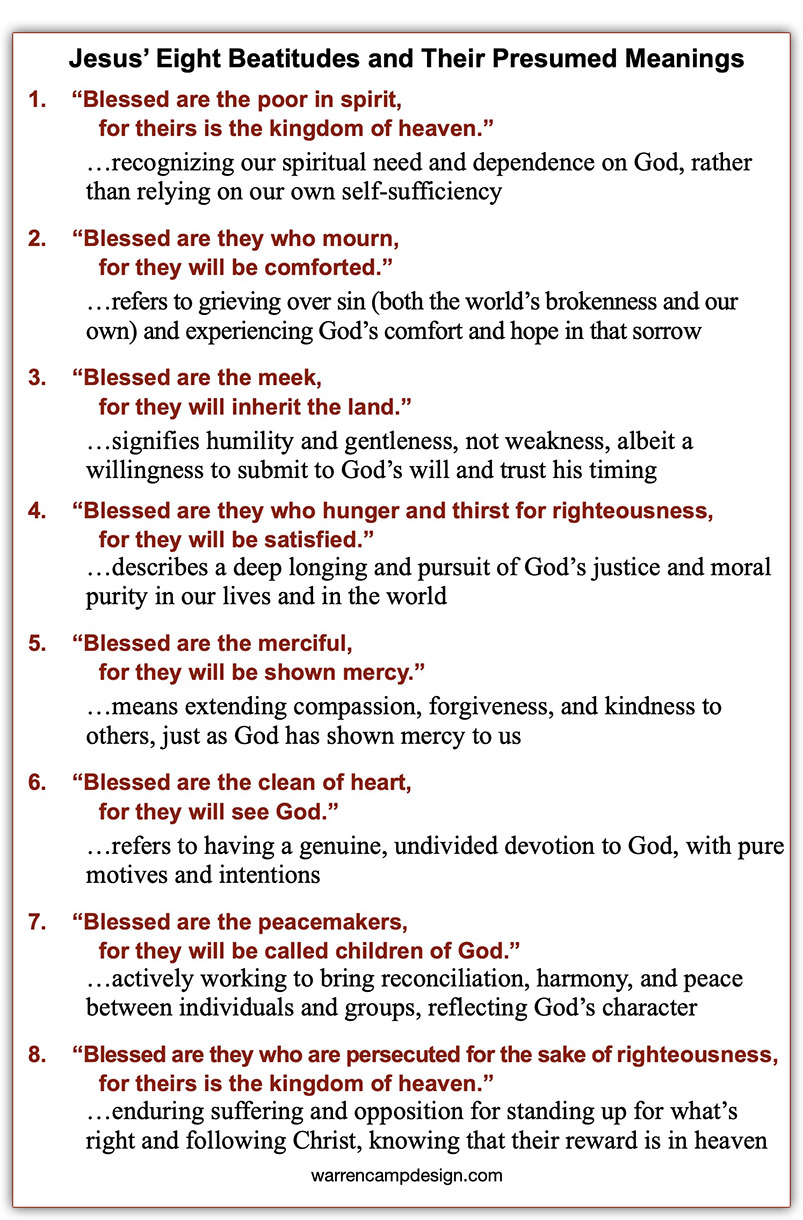
Click to enlarge and read all eight of Warren’s
suggested “blessed” Beatitudes meanings.
Jesus had announced, “Repent, for the kingdom of heaven has come near” (Matt. 4:17). The Greek word metanoia, translated “repentance,” speaks of a change of mind and direction that results in a transformed life. Jesus had also called his first disciples — Simon Peter, Andrew, James, and John — to follow him and join his life-changing mission (vv. 18–22).
Within this literary setting, the Beatitudes may be read as Jesus’ manifesto for the transformed community he’s inaugurating. They describe the kind of people this kingdom forms and blesses. Jesus speaks to men and women who know grief, oppression, spiritual need, and opposition because of their pursuit of righteousness.
Jesus delivers this sermon to his disciples, while crowds also remain nearby and hear his teaching (Matt. 5:1–2; 7:28). Having called his first disciples and begun his public ministry, Jesus now teaches with divine authority about the life of God’s kingdom. Such teaching comes after he calls his first disciples (Andrew, Peter, James, and John). See this 5-minute video by The Chosen: “Jesus Calls Peter.”
Eight primary declarations of blessing comprise the Beatitudes. Verses 11–12) extend and personalize the eighth Beatitude, applying it directly to disciples who are persecuted because of Jesus.
“Note, also, with delight, that the blessing is in every case in the present tense, a happiness to be now enjoyed and delighted in. It is not ‘Blessed shall be,’ but ‘Blessed are’” (Charles Spurgeon). As he sees it, Jesus pronounces happiness as an immediate, ongoing possession for believers rather than a distant future promise.
1. † Blessed are the poor in spirit, for theirs is the kingdom of heaven (5:3). Jesus uses “kingdom of heaven” to speak of God’s reign — his saving rule that’s drawn near in Jesus. To be “poor in spirit” is to recognize one’s spiritual poverty and absolute dependence upon God. Those who know their need for God’s grace are blessed because the kingdom belongs to them now.
The poor may include people who experience material hardship, but “poor in spirit” points beyond economic circumstances to humble dependence on God. In a world of violence, corruption, and self-sufficiency, Jesus blesses those who abandon self-reliance and cast themselves upon the mercy of God.
Ever feel like you just don’t have it all together? To be “poor in spirit” isn’t about material poverty or lack of self-worth; it’s recognizing our complete spiritual dependence on God. It means coming to him with open hands, acknowledging that we cannot save or sustain ourselves without his grace.
This beatitude is first, because this is where we start with God. “A ladder, if it is to be of any use, must have its first step near the ground, or feeble climbers will never be able to mount. It would have been a grievous discouragement to struggling faith if the first blessing had been given to the pure in heart; to that excellence the young beginner makes no claim, while to poverty of spirit he can reach without going beyond his line” (Spurgeon; 1873 sermon).
Application message: Try letting go of the pressure to be self-sufficient this week, and open your day with a simple prayer acknowledging your need for God’s guidance.
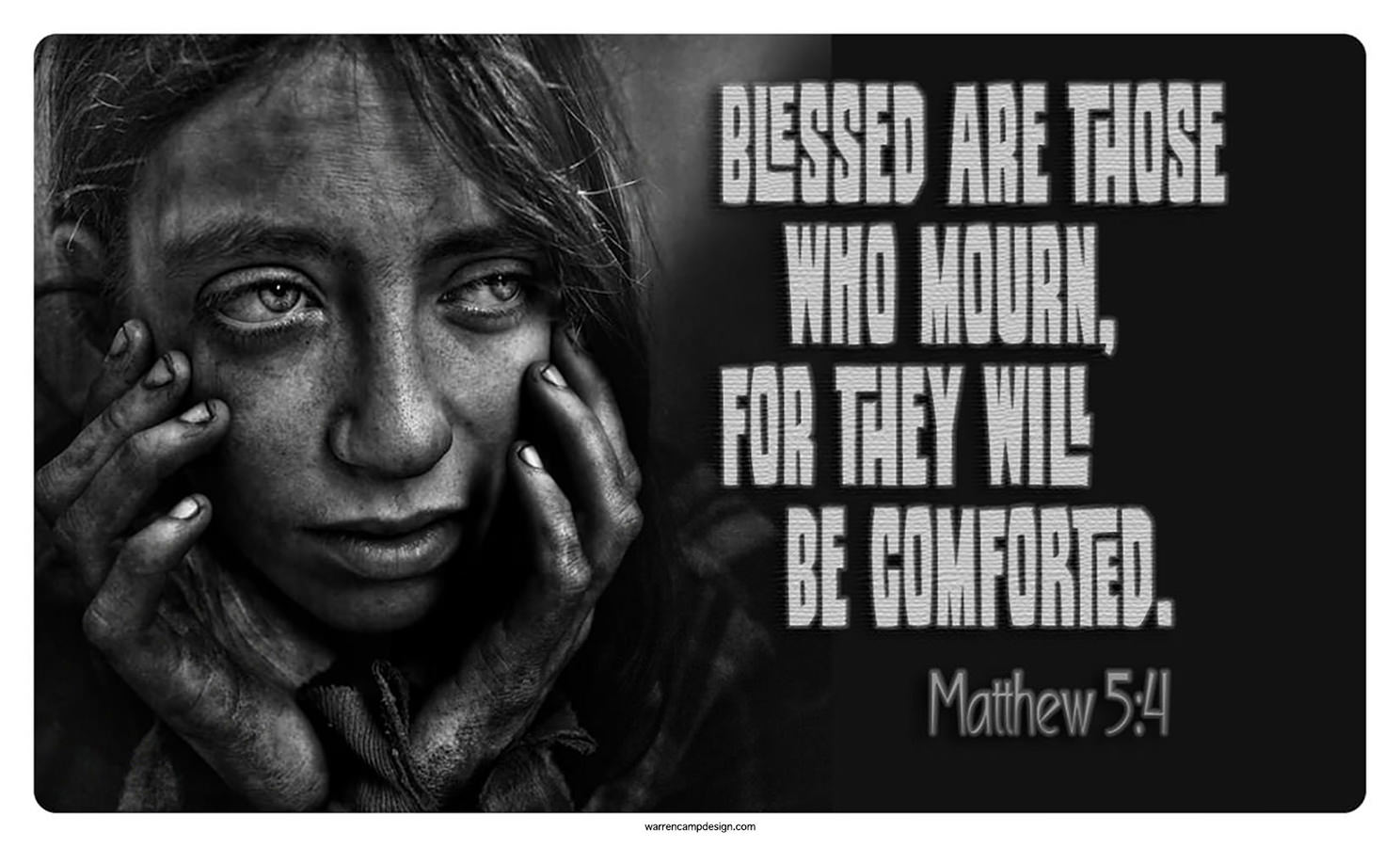
Click to enlarge and download
Matthew 5:4.
2. † Blessed are those who mourn, for they will be comforted (5:4). Mourning may include grief over personal loss, but in this context it especially includes sorrow over sin and brokenness of the world. The promise is certain: God will comfort his people through his sustaining presence now and through the complete restoration of his kingdom in the age to come.
Can severe heartbreak actually become a sacred space where God meets you closest? Jesus speaks of a holy grief — mourning over our own sin, the brokenness of our world, and the pain of others. God promises that those who dare to grieve will experience his supernatural comfort.
The Greek verb translated “mourn” expresses deep and intense grief, the kind of lament associated with bereavement. Jesus speaks of those who are honest about the tragedy of sin in their own lives and in the world, and who therefore look to God for comfort and redemption.
Application message: Take time this week to sit honestly with a grief or regret you’ve been avoiding, inviting God to meet you right in the middle of it.
3. † Blessed are the meek, for they will inherit the earth (5:5). The world often celebrates aggression, domination, harshness, and self-advancement. Jesus instead blesses the meek — the gentle who entrust themselves to God’s justice. Echoing Psalm 37:9, 11, he promises that they’ll inherit the earth.
What changes when you realize that gentleness is actually power under God’s control? Society often rewards the loudest and most aggressive voices, but Jesus exalts the meek — those whose hearts are quieted by faith in God’s sovereignty. To be meek is to surrender our need to control outcomes and trust God to defend and direct us.
Meekness isn’t weakness. It’s strength submitted to God’s control. The meek don’t need to seize power or insist on their own way, because they trust the Lord to establish justice and grant them their inheritance in the renewed earth.
Application message: In your next moment of frustration or disagreement, practice restraint by choosing a soft answer over a sharp reaction.
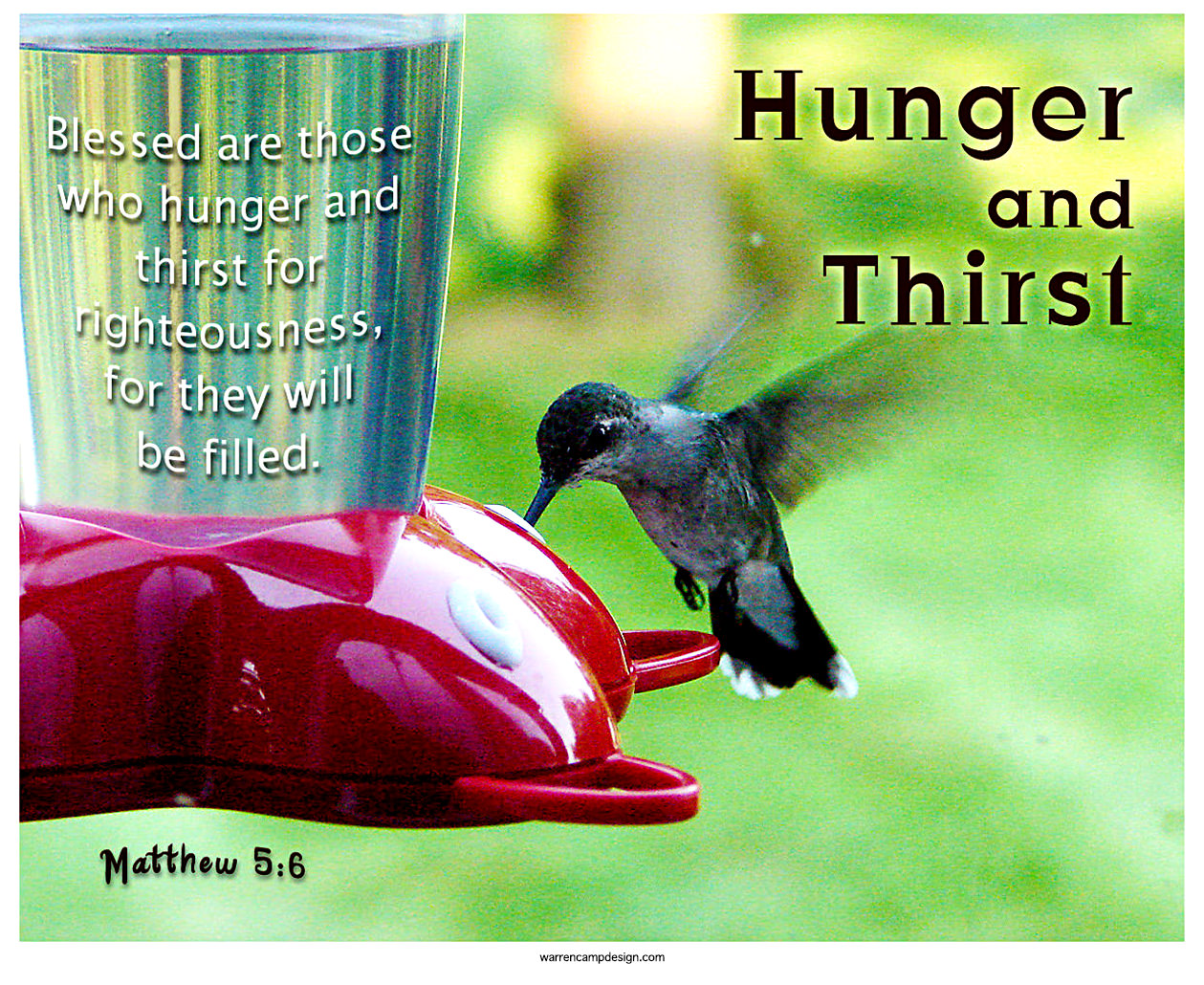
Click to enlarge and download
this image of Beatitude 4:
Matthew 5:6.
4. † Blessed are those who hunger and thirst for righteousness, for they will be filled (5:6). This Beatitude describes an intense longing for God’s moral rightness and just rule. Those who hunger and thirst for righteousness long to see God’s will done in their own lives, among his people, and throughout the world.
Are you running on spiritual empty, looking for satisfaction in all the wrong places? Jesus highlights a deep spiritual appetite — a craving to see God’s goodness, truth, and justice established in our lives and world. He promises that those who seek him with the same urgency as a starving person seeks food will find true, abiding fulfillment.
Such disciples desire a right relationship with Father God, growth in holiness, justice for others, and moral integrity in every sphere of life. God Almighty promises that their deepest longing won’t be empty: He’ll satisfy them.
Application message: Choose one daily habit this week (like scrolling through social media or watching TV) and intentionally replace 15 minutes of it with prayer or reading Scripture to feed your soul.
Watch BibleProject’s superb video.
5. † Blessed are the merciful, for they will be shown mercy (5:7). Mercy is compassion expressed in action. It doesn’t earn a person entrance into God’s kingdom; rather, merciful conduct demonstrates the work of God’s mercy in a disciple’s heart. As Micah teaches, God calls his people to do justice, love mercy, and walk humbly with him (Mic. 6:8).
How would your relationships transform if you led with grace instead of judgment? Mercy is grace in action — it boils down to withholding harshness while actively offering compassion to those who fail or suffer. Because believers have been showered with infinite mercy, thanks to Jesus at the cross, we’re empowered to become channels of that same mercy to others.
Those who’ve received God’s mercy learn to extend mercy to others. They reflect their Father’s heart, and they may live with the assurance that God will show them mercy.
Application message: Reach out to someone who made a mistake or let you down recently, offer him or her a word of encouragement or reassurance.
6. † Blessed are the pure in heart, for they will see God (5:8). Jesus directs attention to the center of human life: the heart. To be pure in heart is to live with sincerity, integrity, and an undivided devotion to God rather than a divided allegiance.
What if seeing God at work around you starts with purifying what’s happening inside you? Purity of heart isn’t about legalistic perfection; it’s about an undivided loyalty and authentic devotion to God. When our motives are cleansed from hypocrisy and self-seeking, our spiritual perception clears, allowing us to recognize God’s presence everywhere.
The promise is astonishing: The pure in heart “will see God.” They experience his presence now and await the day when they’ll know him fully. Their greatest reward isn’t merely an improved life, but communion with God himself.
No one practices pure-hearted love flawlessly; mixed motives can be present even in good actions. Yet Jesus calls his disciples toward the wholehearted love and integrity that reflect their Father’s character. A heart increasingly devoted to God learns to recognize his work in Scripture, creation, and the life of the church.
Application message: Pray Psalm 51:10 (“Create in me a clean heart, O God”) at the start of each morning this week to align your motives with his.

Click to enlarge and download Warren’s
Scripture picture of Matthew 5:9.
7. † Blessed are the peacemakers, for they will be called sons of God (5:9). Peacemakers do more than avoid conflict. In fact, they actively seek reconciliation with God and other people. In Jesus, God’s kingdom confronts the hostility and division produced by sin.
What if you stopped avoiding difficult conflicts and started actively building bridges instead? Peacemaking is dynamic and courageous; it requires stepping into places of discord to bring God’s shalom — wholeness, truth, and reconciliation. When we work to repair broken relationships, we reflect the very nature of our heavenly Father.
Jesus is the supreme Peacemaker. Through him, God makes peace between himself and humanity and creates a reconciled people from those who were once divided (Ephesians 2:14–18; Colossians 1:20). Those who pursue peace reflect God’s character and are rightly recognized as his children.
Application message: Take a proactive step toward peace this week by offering an apology where you were wrong or listening generously and graciously to someone with whom you disagree.
Watch BibleProject’s superb video.
8. † Blessed are those who are persecuted because of righteousness, for theirs is the kingdom of heaven (5:10). Life as a peacemaker and faithful disciple can be costly. Jesus doesn’t promise an easy path; he acknowledges that those who pursue righteousness may face resistance, rejection, and suffering.
What if facing pushback for doing what’s right is actually proof that you’re living like Jesus? Living by kingdom values will inevitably clash with a culture focused on self-interest and pride. When faithfulness to God brings misunderstanding or criticism, Jesus tells us to rejoice, knowing our identity and eternal reward are secure in him.
The Beatitudes aren’t entrance requirements by which a person earns a place in God’s kingdom. They describe the character God forms in those who receive his grace. Those who suffer because of righteousness are assured that the kingdom is theirs, both now and in its future fullness.
Application: When you face subtle pressure or disapproval for standing up for Christian values, respond with gentleness and unwavering confidence in God.
 Finally, we come to the concluding or climactic Beatitude. The movement from “Blessed are those…” to “Blessed are you…” makes vv. 11–12 a particularly fitting climax to Jesus’ Beatitudes.
† Blessed are you when people insult you, persecute you and falsely say all kinds of evil against you because of me. Rejoice and be glad, because great is your reward in heaven, for in the same way they persecuted the prophets who were before you (5:11–12). Jesus addresses his disciples personally. Persecution includes insults, slander, and false accusations, not only physical violence. The important qualification is “because of Me”: suffering for Christ isn’t the same as suffering due to careless conduct, foolishness, or sin.
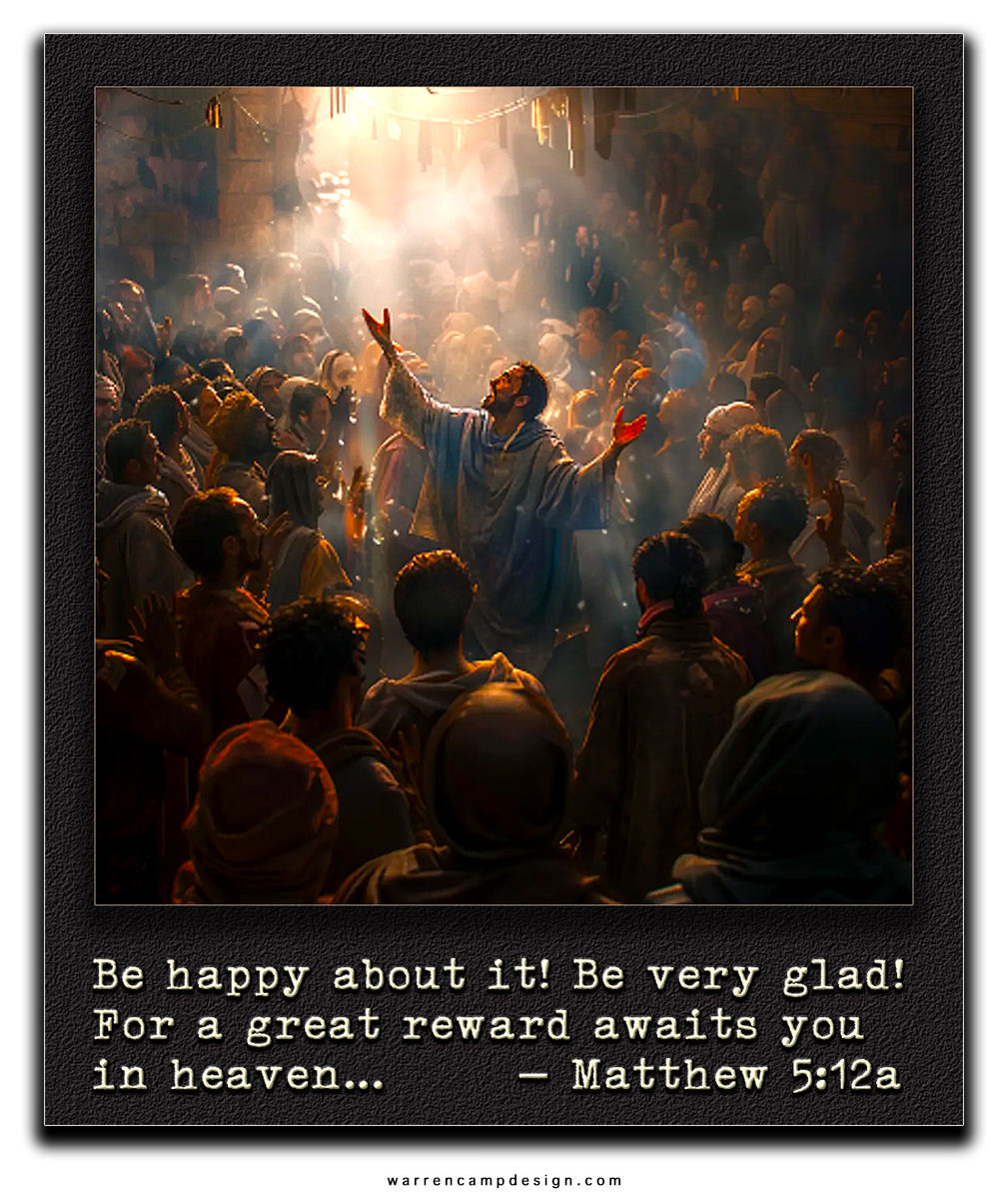
Can you actually find joy in moments when people misrepresent or oppose you because of Jesus? In vv. 11–12, Jesus makes the lesson personal, shifting from “those” to “you.” He warns that following him will bring personal insults, false accusations, and pushback. But he reframes this opposition: It aligns you with the prophets of old and seals a heavenly reward that no earthly hardship can touch.
Jesus calls persecuted disciples to rejoice — not because suffering itself is good, but because persecution for his sake identifies them with the prophets and points to their secure reward with God. The world resists the character and values of the Beatitudes because they stand against its sinful patterns of pride, self-rule, retaliation, and injustice.
Our experience may be less severe than that of many believers around the world. Nevertheless, Christ’s question remains searching: Does our life bear enough of his character that it differs meaningfully from the world’s way of thinking and living?
Application message: When you experience friction or coldness for honoring God this week, reframe it in your mind — don’t view it as a personal defeat, but as confirmation that your light is shining brightly.
Conclusion The Beatitudes reveal the values, promises, and character of God’s kingdom. They call believers to a radical, countercultural life shaped by humility, mercy, purity, peacemaking, and a deep hunger for righteousness. These blessings aren’t wages earned by spiritual effort; they’re the gracious assurance of God’s favor toward those who follow Christ, now and in the age to come.
This 15-minute video highlights Jesus’ teaching of his ‘Sermon on the Mount,’ compliments of The Chosen.
- Q. 1 Which Beatitude speaks most deeply to your present circumstances, and why?
- Q. 2 What internal or external obstacle most hinders you from living out that Beatitude?
- Q. 3 How does Jesus’ promise of blessing reshape your understanding of what a truly good, fulfilled life is?
If you’ve heard about Jesus of Nazareth, you likely know he was a famous teacher, and his most well-known words, recorded in the Sermon on the Mount, have shaped countless lives. Some of his teaching has become proverbial, statements such as “Love your neighbor as yourself” or “Do unto others what you would have them do to you.” The Sermon on the Mount is short — only three chapters long — but its timeless ideas and images continue to endure.
In Warren’s commentary collection, you can learn more about the big picture of Jesus’ central teaching, while you explore related videos, Q & A’s, relevant Scripture pictures, a 25-question Sermon on the Mount quiz, and lots more.