Join us this winter on your remote study of John’s three epistles. (Follow the menu above.)
Apostle John’s Three Letters . . . 1 John 3:11–15
Love and Hatred, Life and Death
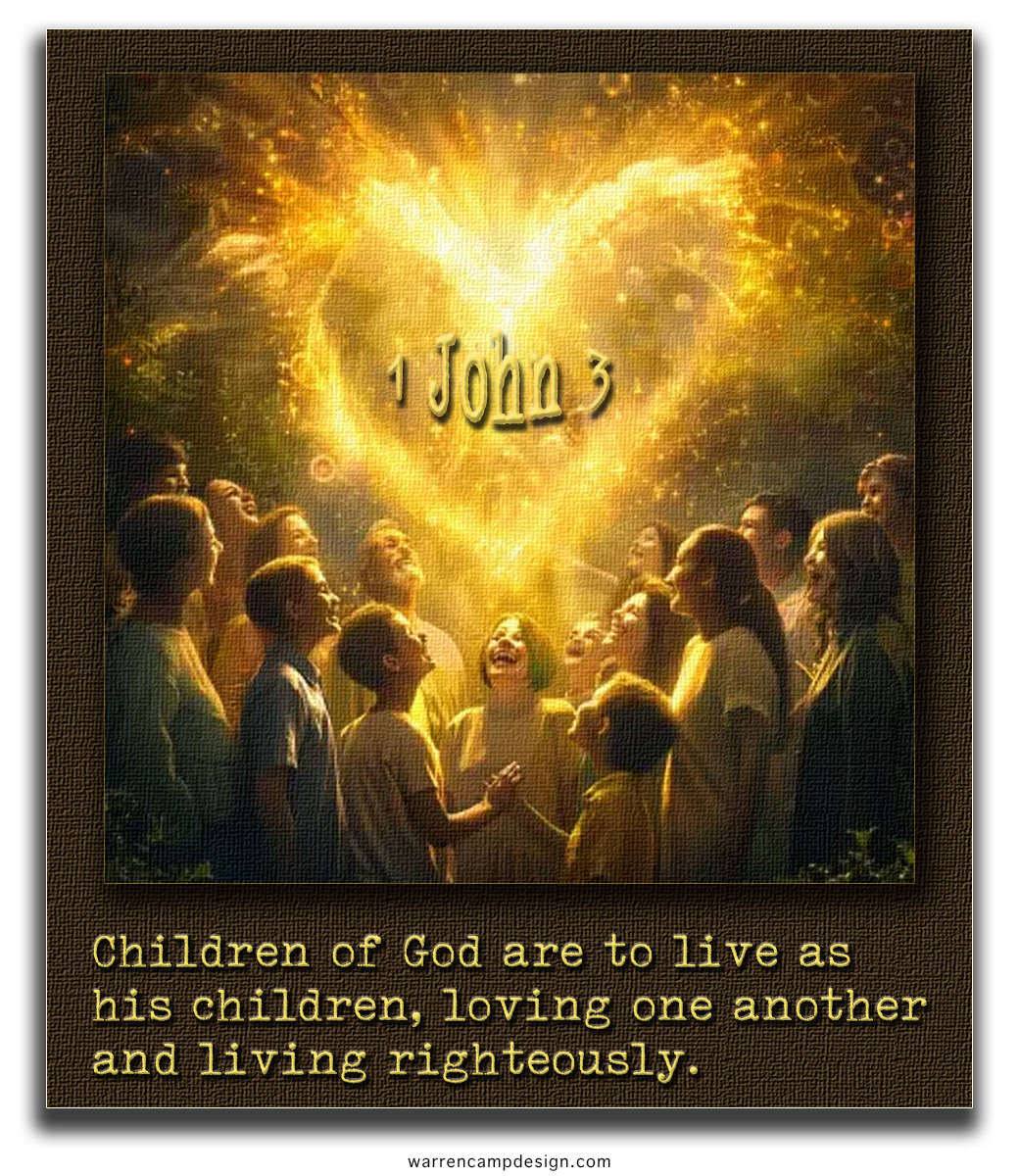
Love isn’t proved by warm words alone; it’s revealed by what we do when another person’s good costs us something. John takes us back to the message believers heard from the beginning: Love one another. He then places two lives before us — Cain’s hatred, which led to death, and Christlike love, which shows that we’ve passed from death to life.
In the preceding passage, John taught that those born of God increasingly practice righteousness. He now adds another indispensable mark of God’s children: They love their brothers and sisters in Christ. Christian love is more than friendliness, affection, gifts, or occasional acts of kindness. It’s a continuing commitment to seek another believer’s good.
This week’s “love” study will extend to looking at and appreciating our need to practice righteousness and love on fellow believers. But what exactly does the act of “loving someone” entail? Giving someone a warm hug? Sending an appropriate gift? Volunteering to do something special? What is it that comes to mind when you’re asked or told to “Love somebody”?
John’s contrast in vv. 11 and 12 is severe. Cain hated his brother, and his hatred led to murder. John warns that hatred toward a brother or sister is incompatible with the life God gives. Love, however, is evidence that believers have passed from death to life.
This passage calls for honest self-examination. Are we nurturing resentment, contempt, envy, bitterness, or indifference toward another believer? God’s command to love doesn’t mean pretending sin is unimportant or avoiding difficult conversations. It means refusing hatred and seeking to treat others with the truth, mercy, patience, and practical concern that Christ has shown us.
The World’s Hallmark of “Hatred” (1 John 3:11–13)
John repeatedly returns to love because love for fellow believers is essential evidence of life in God’s family. The message is not new: Believers have heard it “from the beginning.” Yet, John now gives it a sobering contrast — Cain’s hatred of Abel — and warns that the unbelieving world will often respond with similar hostility toward those who belong to Christ.
As we learned in our introductory study, John didn’t hesitate to use key words repeatedly in all three of his letters to drive home essential themes. In his three epistles, he used “love/loves/loved” fifty-two times [in the NIV].
More on Love and Hatred
11For this is the message you heard from the beginning: We should love one another. 12Do not be like Cain, who belonged to the evil one and murdered his brother. And why did he murder him? Because his own actions were evil and his brother’s were righteous (1 John 3:11–12).

Click to enlarge and print.
The command to love one another is part of the original Christian message. Jesus commanded his disciples, “Love one another. As I have loved you, so you must love one another” (John 13:34–35). Christian love is more than warmth, words, gifts, or occasional kindness. It’s a continuing commitment to seek the spiritual and practical good of brothers and sisters in Christ. [See “Agape love.”]
John directs his readers to Cain as a warning. Cain didn’t merely have a moment of anger; his jealousy and hatred toward Abel led to murder. John says that Cain “belonged to the evil one” because his actions were evil, while Abel’s were righteous. Cain resented the righteousness of his brother rather than responding to God in repentance. [See the good and bad about Cain.]
John’s point isn’t that every conflict between believers is equivalent to Cain’s murder of Abel. Rather, hatred belongs to the same spiritual direction as Cain’s violence. Resentment, envy, contempt, and a desire to harm another person must be brought into Christ’s light before they grow into deeper sin. Today, Jesus continues to care for and love us beyond measure.
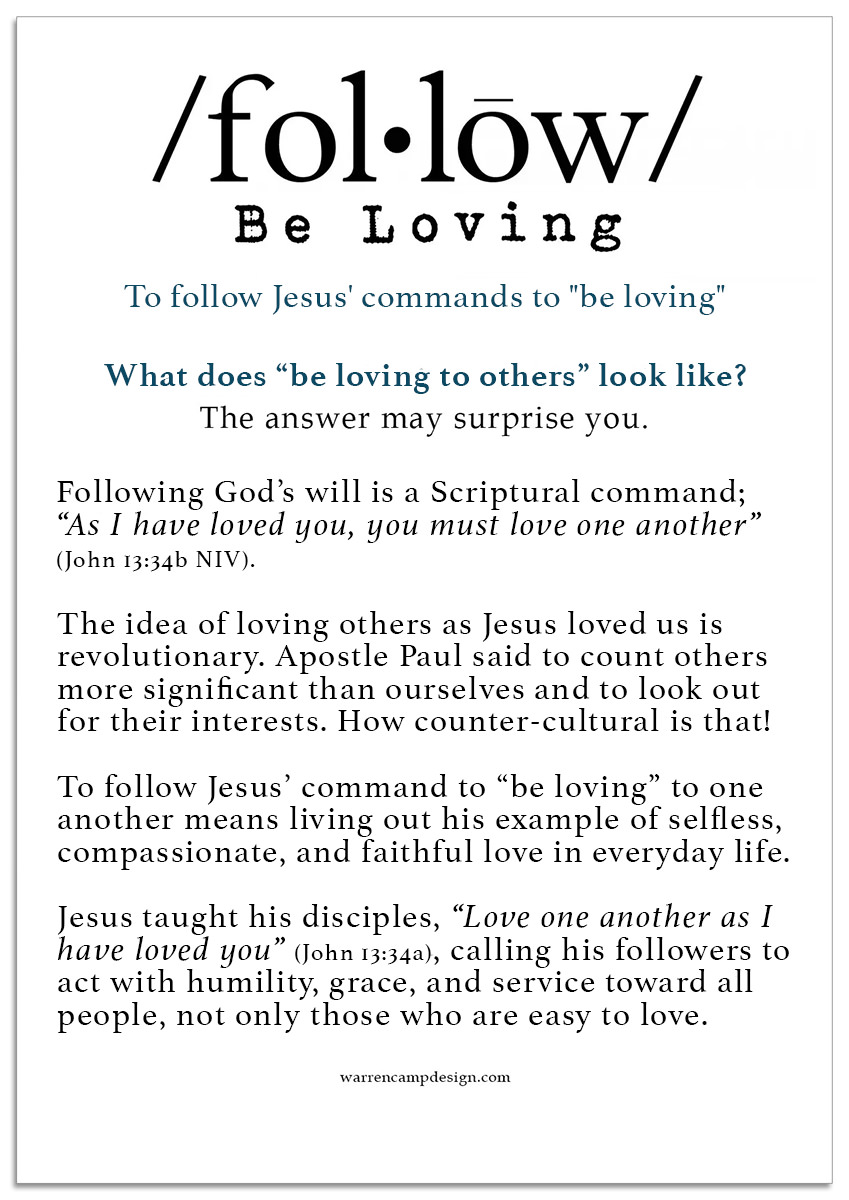
Click to see Warren’s take on
“How to follow.”
Follow these reminders: (1) Love starts by receiving. Before you can pour out love, you must first let God fill you with his. Spend quiet time in his presence, remembering how patiently he has loved and forgiven you; (2) Jesus redefined “neighbor” to include everyone in need — even those who differ from us; (3) Words of love are easy; actions of love are costly. True discipleship expresses love through service, generosity, and patience; and (4) Forgiveness is one of the hardest, yet holiest, ways to love. When you forgive, you release both yourself and the other person into God’s hands.
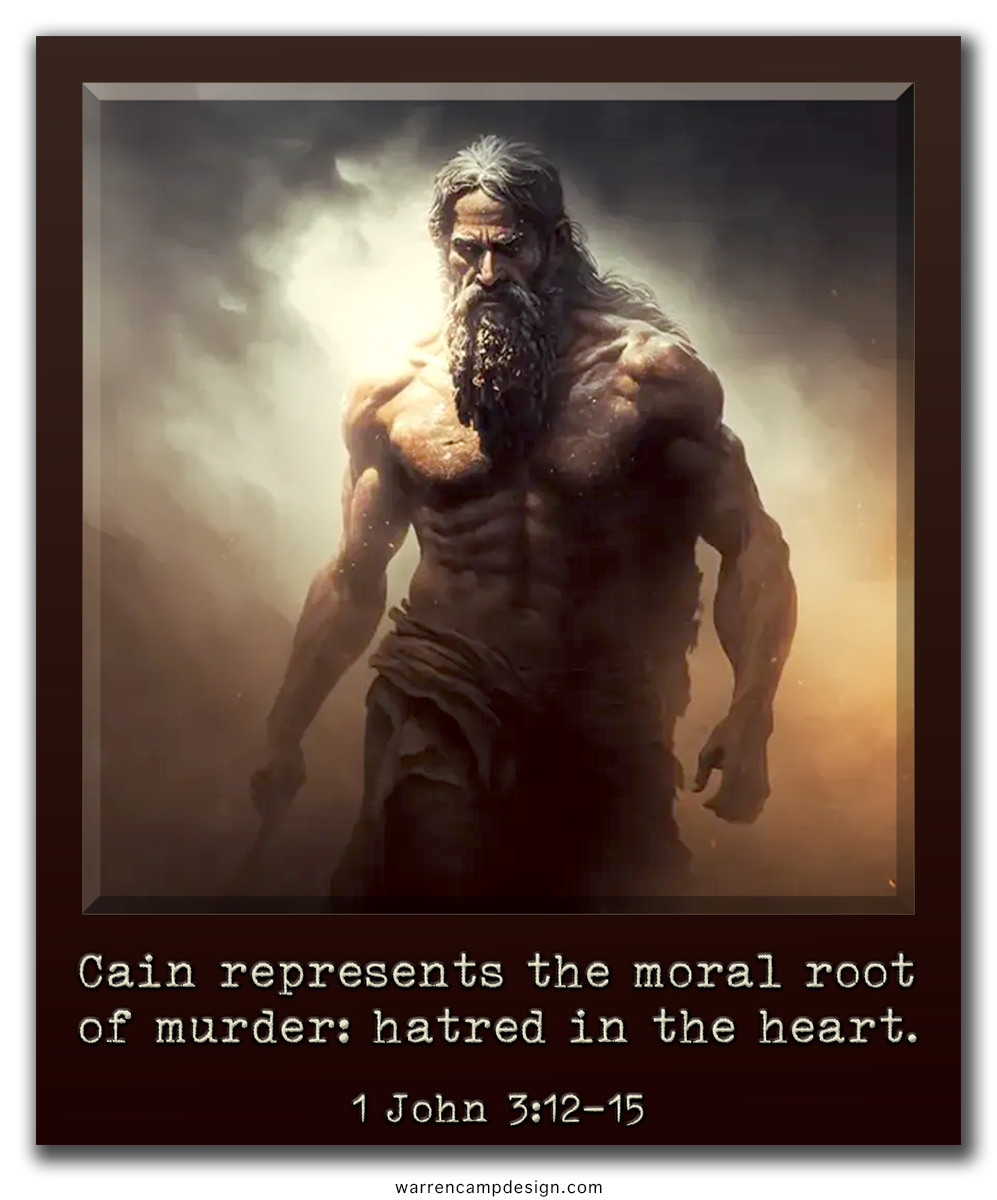
The Contrast: Brotherly Love vs. Cain’s Motive John opens this passage by reminding his readers of the foundational message: “We should love one another.” Immediately after, he invokes Cain as the ultimate counter-example. John notes that Cain “belonged to the evil one” and murdered his brother Abel. Cain’s resentment grew because his own deeds were righteous in appearance only or lacked faith, whereas Abel’s offering was accepted. Jesus addressed this same heart condition in the Sermon on the Mount (Matthew 5:21–22), teaching that nursing contempt or bitter hatred toward a brother carries the same moral trajectory as murder. Hatred is essentially murder in seed form — it desires the removal or devaluation of the other person. In the verses that follow (3:14–15), John makes the ultimate distinction: transitioning from spiritual death to spiritual life is marked by genuine love for fellow believers.
The world’s hallmark is hatred. After telling his church members that they “should love one another,” John warns them not to be the hater that Cain was. He attributes the lack of brotherly love in Cain’s experience to his parentage; he wasn’t a child of God, he was of that wicked one, Satan (v. 12a). He was hostile towards brother Abel because Abel was right with God and Cain wasn’t.
John immediately highlighted the love that they were to have and express outrightly for one another, contrasting that with Cain’s murder of his brother. Next read this follow-up forewarning in v. 13.
13Don’t be surprised, my brothers and sisters [believers who are in God’s family], if the world hates you (1 John 3:13).
Using “the world” in v. 13b, John was generally referring to the unbelieving world of which Satan currently had control, the fallen order that doesn’t know God and resists his truth. Therefore, believers shouldn’t be shocked when their loyalty to Christ brings misunderstanding, criticism, or opposition. Jesus himself warned his disciples that the world’s hostility toward them followed its prior hostility toward him (John 15:18–19).

Click to enlarge Warren’s image: “1 John 3:13.”
John doesn’t call believers to return hatred for hatred. The response to a hostile world isn’t fear, self-pity, or retaliation, but faithful love, righteous conduct, and steadfast commitment to Christ. Love within the church becomes especially important when believers face pressure from outside it.
Going forward in this first epistle, John the apostle will make it abundantly clear in three essential verses that many false prophets “have gone out into the world” (4:1), they live and act by “the spirit of the antichrist, which…is even now in the world” (4:3), and “They are from the world and therefore speak from the viewpoint of the world, and the world listens to them” (4:5).
Next we come to the element in today’s passage that deals with death and life.
From Death to Life (1 John 3:14–15)
John has warned that the world’s hatred shouldn’t surprise believers. He now turns from the world’s hostility to an encouraging assurance within the Christian community: Love for fellow believers is evidence that God has brought us from spiritual death into eternal life.
14We know that we have passed from death to life, because we love each other. Anyone who does not love remains in death. 15Anyone who hates a brother or sister is a murderer, and you know that no murderer has eternal life residing in him (1 John 3:14–15).
…from Bible.art
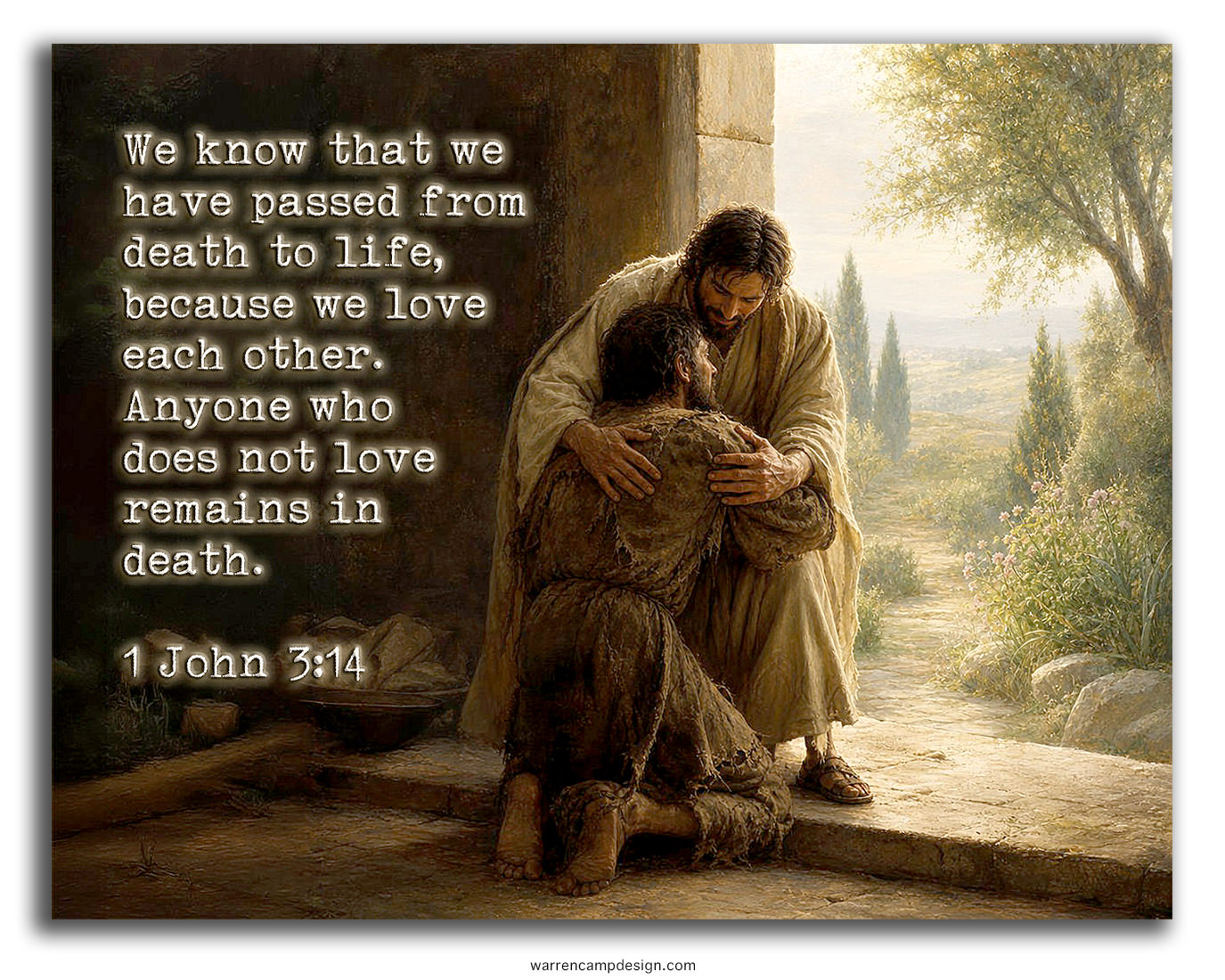
“Anyone Who Does Not Love
Remains in Death”
Click to enlarge Warren’s custom image:
“Acts 3:14”
Verse 14 gives believers a meaningful assurance. John says, “We know that we have passed from death to life, because we love each other.” Love for fellow Christians isn’t the basis on which we earn eternal life; it’s evidence that God’s life is active within us. Those who’ve been born of God increasingly love his people.
To have “passed from death to life” describes a decisive change brought about by God. Apart from Christ, people remain spiritually dead; through faith in him, believers receive eternal life. John points to love as one visible sign of that new life.
John then states the sobering opposite: “Anyone who does not love remains in death.” He isn’t describing every believer who struggles with a difficult relationship, feels hurt, or needs time to work through conflict. He’s warning against a settled posture of lovelessness, bitterness, contempt, or hatred toward a brother or sister in Christ.
Verse 15 intensifies the warning: “Anyone who hates a brother or sister is a murderer.” John doesn’t say that inward hatred and the physical act of murder have identical earthly consequences. Rather, he exposes hatred’s true spiritual character. Hatred rejects another person’s good and belongs to the same destructive direction that led Cain to murder Abel.
No one should use this verse to say that a murderer can’t be forgiven. Christ’s grace reaches sinners who repent and trust in him. John’s point is that a person can’t claim to possess eternal life while choosing to remain in hatred without repentance. Eternal life produces a new direction: love rather than hatred, life rather than death.
Hatred often appears not only in open hostility but also in selfish disregard for another person’s good. It may take the form of resentment, envy, contempt, indifference, a refusal to forgive, or pleasure at another person’s failure. John calls believers to bring such attitudes into Christ’s light and to seek the good of their brothers and sisters.
John gives us several sobering truths about hatred in these verses. Each stands in direct contrast to the love God calls his children to display:
› Cain provides a warning example of hatred (v. 12). His hatred toward Abel did not remain hidden; it led to murder.
› Hatred belongs to the evil one’s work (v. 12). Cain “belonged to the evil one,” and his conduct reflected that evil allegiance.
› Hatred resents righteousness (v. 12). Cain murdered Abel because Cain’s actions were evil while Abel’s were righteous.
› Hatred belongs to the realm of death (vv. 14–15). A settled refusal to love a brother or sister reveals spiritual death rather than eternal life.
› Hatred is incompatible with God’s life in us (vv. 14–15). Those who have passed from death to life increasingly show that new life by loving fellow believers.
John’s message is serious: Hatred destroys, divides, and reflects the world’s rebellion against God. But he doesn’t leave us with hatred’s darkness. In the verses that follow, he points us to the defining mark of God’s family — love that takes its pattern from Christ, who laid down his life for us.
Closing Considerations
Few people would want to think of themselves as murderers. It’s one of those sins about which many say, Well, I’m an okay person; it’s not like I’ve ever killed anyone! But the Apostle John, here, puts forward the topic of murder convincingly. Equating a hateful heart with a most heinous crime is the difficult reality that he presents before the church. You might as well be Cain is the message he presents to those who’d want to set aside a concealed contempt for a brother. John’s main idea: The one who doesn’t love his brother hates him. We can hate or love one another; there’s no option in God’s law. The fruit that will be born from a hateful or loving heart will naturally depend on the nature of the vine.
What do you mean when you say, “I’m a Christian.” Some people claim to be a Christian but aren’t. How can we know if we’re one of them? John’s epistle has been clear and consistent. We’re to take and pass three tests that prove Christian authenticity: the truth test, the morals test, and the love test (described in detail in Warren’s commentary on 1 John 1:1–4). That is, if we believe that what the Bible teaches is true, if our conduct has been changed and is becoming more like Jesus, and if we demonstrate Jesus’ love to others, then we’ll have passed the three tests and our claim to be a Christian can be proven true.
Christians: To love one another is to love fellow believers the same way that Christ loves us. Those who love as Christ loves, utilizing the Holy Spirit’s power, will confirm that they’re active Christian disciples — learners and followers — of Jesus Christ.
- Q. 1 How does John’s command to “love one another” differ from the world’s common ideas of love?
- Q. 2 According to vv. 14–15, what does love for fellow believers reveal about a person’s spiritual life? What does persistent hatred reveal?
- Q. 3 Why does John use Cain as a warning example? What attitudes can become the first steps toward hatred?
- Q. 4 How might you practice Christlike love toward a brother or sister in Christ this week? Whose good can you intentionally seek through encouragement, service, forgiveness, or practical help?
1 John 3:11–15 (NIV)
Read the passage in another Bible version or listen to 1 John, chapter 3, read by Max McLean.
Summary Video
Watch this BibleProject overview of 1, 2, and 3 John.
Review and Prepare
Quiz time! Take Warren’s “John’s Three Epistles Quiz” now — or bookmark it and take it later.
You may also see Warren’s other Bible-study quizzes.
