Jesus’ “Sermon on the Mount”. . . Matthew 6:25–34
“Do Not Worry”
In this section of his Sermon on the Mount, Jesus continues to address the divided heart. Having warned that no one can serve both God and money, he now speaks to the anxiety that often drives our pursuit of material security. He knows that concerns about food, clothing, housing, health, work, and the future can easily consume our thoughts. Jesus doesn’t minimize genuine human needs. Instead, he invites his disciples to bring those needs into the care of their heavenly Father rather than allowing fear to become their master.
In Matthew 6:25–34, Jesus teaches that anxious worry can’t add to our lives or secure the future we fear. He points his followers to God’s generosity in creation — the birds of the air and the flowers of the field — as reminders that Father God sees, knows, and cares. Jesus’ answer to worry isn’t denial, passivity, or irresponsible planning. It’s a renewed trust that seeks God’s kingdom and righteousness first, while receiving each day’s needs and troubles in dependence on him.
Moving directly from the impossibility of serving two masters (6:24), Jesus addresses the anxiety that can drive our pursuit of material security. In vv. 25–34, he speaks to the everyday concerns of life — what we’ll eat, drink, and wear — and invites his disciples to exchange anxious self-reliance for a growing trust in the faithful care of their heavenly Father.
Matthew uses the Greek word merimnaō for “worry” or “concern.” The New Testament can use related language for appropriate care or concern, but Jesus warns here against anxious preoccupation with needs and circumstances we can’t control. Here you can watch an exceptional video clip from BibleProject titled “Wealth and Worry” (7 minutes). Also watch this video clip by Jesus Film Project that depicts Matthew 6:19–34 of Jesus’ famous sermon (3 minutes).
Jesus’ words require careful and compassionate application. He isn’t shaming people who live with clinical anxiety, depression, trauma, grief, chronic illness, poverty, food insecurity, unemployment, or other heavy burdens. Such struggles may involve body, mind, relationships, circumstances, and spiritual life. Seeking medical care, counseling, pastoral support, medication when appropriate, practical assistance, or help from trusted family and friends isn’t a failure of faith. It can be one way of receiving God’s care through the people and resources he provides.
At the same time, Jesus lovingly confronts the kind of worry that repeatedly pulls our hearts away from trust in God and binds us to imagined futures we can’t control. He calls us to bring our fears honestly to our Father, take responsible action where action is possible, and release what remains beyond our power. His command isn’t “never feel concern,” but “do not let anxious concern become the master of your life.”
The Radical Halt to Worry: Reorienting Life Beyond Survival (6:25)
Transitioning directly from his warning against serving “mammon,” Jesus addresses the anxiety that inevitably fuels our pursuit of wealth. In v. 25, he issues a direct command to stop the frantic cycle of everyday worry, challenging his listeners to recognize that human existence is defined by something far greater than mere biological survival.
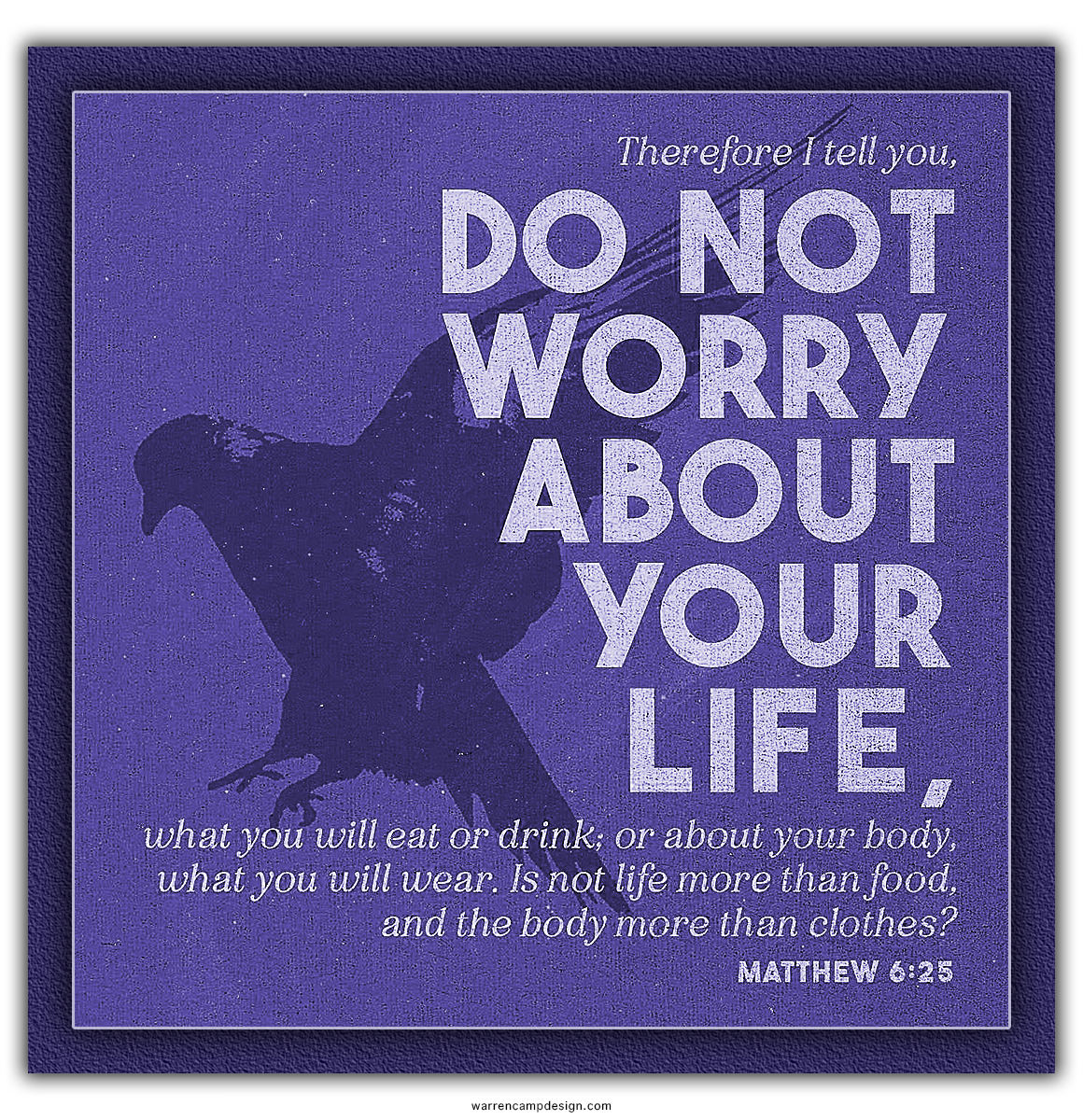
“Therefore I tell you, do not worry about your life, what you will eat or drink; or about your body, what you will wear. Is not life more than food, and the body more than clothes?” (v. 25, NIV).
Jesus begins with a direct command: “Do not worry about your life.” The Greek word merimnaō can refer to concern or anxiety; in this context, Jesus addresses the anxious preoccupation that dominates the mind and pulls attention away from trust in God. He’s not asking us to become careless, indifferent, or unprepared. He’s calling us away from the exhausting attempt to control every outcome through fear. Worry can make us feel responsible for carrying burdens that God never asked us to carry alone.
Click to enlarge and download
Matthew 6:25.
Jesus names the basic needs that can stir deep anxiety: food, drink, and clothing. These aren’t trivial matters. Many people in Jesus’ first-century setting lived close to subsistence, and many people today know the real pressure of limited income, rising costs, illness, or uncertainty about the future. Jesus isn’t criticizing those who work to provide for themselves and their families. He’s addressing the way fear can make physical survival seem like our ultimate project, causing us to forget that life itself is a gift from God and that the Father knows our needs.
The Greater Purpose of Human Life Jesus closes the verse with a searching question: “Is not life more than food, and the body more than clothes?” Food and clothing matter, but they’re not the whole meaning of life. God created us for fellowship with him, love of neighbor, faithful service, and participation in his kingdom. When anxiety fills every corner of our minds, it can shrink life down to mere survival. Jesus lifts our eyes again to the Giver of life and reminds us that our physical needs, though real, do not define our ultimate purpose.
Jesus’ command doesn’t oppose wise planning. Scripture commends diligent work, saving, providing for one’s household, seeking help in times of need, and making prudent decisions. The difference is between responsible stewardship and anxiety-driven control. Stewardship asks, “What wise step can I take today?” Worry insists, “Everything depends on me, and I must secure every possible future.” Jesus calls us to work faithfully and plan wisely while remembering that our lives finally rest in our Father’s hands.
The Lesson of the Sparrows: Unburdened Trust Vs. Futile Worry (6:26–27)
Having challenged the underlying anxieties of human survival, Jesus now turns his listeners’ eyes toward the natural world to teach a profound lesson in trust. In vv. 26 and 27, he contrasts the effortless, daily provision given to the birds of the air with the complete inability of human fretting to alter our circumstances.
“Look at the birds of the air; they do not sow or reap or store away in barns, and yet your heavenly Father feeds them. Are you not much more valuable than they? Can any one of you by worrying add a single hour to your life?” (vv. 26–27, NIV).
In these verses, Jesus directs our attention to creation: “Look at the birds of the air.” Birds don’t sow, reap, or store food in barns the way human beings do, yet they live within God’s sustaining care. They search for food, build nests, and labor according to the life God has given them, but their existence doesn’t depend on anxious control of the future. Jesus is n’t endorsing laziness or irresponsibility. He’s inviting his disciples to see that the Creator who sustains birds hasn’t forgotten human beings.
The Value of God’s Children Jesus then uses an argument from the lesser to the greater: “Are you not much more valuable than they?” If the Father attends to the creatures he’s made, how much more does he care for the people who bear his image and whom he calls his children? Our worth doesn’t rest on our income, productivity, possessions, or ability to provide perfectly for ourselves. We’re known and valued by the Father. That truth doesn’t remove every hardship, but it gives us a foundation of care that hardship can’t erase.
Jesus concludes with a practical question: “Can any one of you by worrying add a single hour to your life?” Worry promises control, but it can’t lengthen our lives, guarantee an outcome, or solve tomorrow’s problems before they arrive. It often consumes emotional energy that could be used for prayer, wise action, gratitude, and love. Jesus invites us to recognize worry’s limits, placing our burdens in the hands of the One who holds our days.
Trusting the Generosity of the Creator (6:28–30)
Continuing his outdoor sermon illustrations, Jesus shifts from the animal kingdom to the botanical beauty of the Judean hillsides in vv. 28–30. He contrasts the fleeting, effortless elegance of wild flowers with the expensive anxieties of human fashion, offering a vivid reassurance of God’s abundant care for his children.
“And why do you worry about clothes? See how the flowers of the field grow. They do not labor or spin. Yet I tell you that not even Solomon in all his splendor was dressed like one of these. If that is how God clothes the grass of the field, which is here today and tomorrow is thrown into the fire, will he not much more clothe you—you of little faith?” (vv. 28–30, NIV).
The Beauty of God’s Care Jesus turns from birds to flowers of the field. They don’t labor at weaving clothing or spin thread, yet God clothes them with a beauty greater than Solomon’s royal splendor. Jesus isn’t condemning clothing, careful work, or the enjoyment of beauty. He’s reminding us that God’s generosity is woven into creation itself. Our Father’s care isn’t bare survival alone; the beauty of the natural world points to his abundant and attentive provision.
Temporary Grass and Valued Children Jesus then contrasts the brief life of field grass with the enduring value of human beings. Grass could be cut, dried, and used as fuel in household ovens. If God clothes what’s so temporary, Jesus asks, “will he not much more clothe you?” This is another lesser-to-greater argument. Our Father knows that his children need clothing and daily provision. He calls us to trust his care even when the future isn’t yet visible.
The Gentle Correction of Little Faith “You of little faith” isn’t Jesus’ rejection of discouraged disciples. It’s his loving invitation to let trust in the Father grow larger than fear. Faith doesn’t mean pretending that bills, illness, job loss, or scarcity are unreal. It means bringing these realities before God and learning, again and again, to rely on his wisdom and care. The flowers of the field become a quiet reminder that God hasn’t stopped seeing and caring for his children.
The Great Reversal: Seeking the Kingdom Instead of Survival (6:31–33)
Having exposed the futility of worry through the birds and the wildflowers, Jesus turns from illustration to direct command in vv. 31–33. He challenges his disciples to break free from the frantic, survival-driven patterns of the surrounding culture and to anchor their lives entirely in the relentless pursuit of God’s rule and righteousness.
“So do not worry, saying, ‘What shall we eat?’ or ‘What shall we drink?’ or ‘What shall we wear?’ For the pagans run after all these things, and your heavenly Father knows that you need them. But seek first his kingdom and his righteousness, and all these things will be given to you as well” (vv. 31–33, NIV).
Jesus repeats his warning against anxious concern by naming the questions that easily consume us: “What shall we eat?” “What shall we drink?” and “What shall we wear?” He then says that “the pagans run after all these things.” Jesus isn’t insulting non-Jewish people or denying that people outside Israel face genuine needs. He contrasts a life centered only on material striving with the life of people who know the Father. Those who don’t know God may understandably feel that they must secure life entirely through their own effort. Jesus’ disciples are called to live differently because they know that their heavenly Father sees and knows their needs.
The Comfort of an Attentive Father Thankfully, Jesus gives the antidote to anxious striving: “your heavenly Father knows that you need them.” God isn’t distant, indifferent, or uninformed about our daily needs. He knows our physical frailty, financial pressures, responsibilities, and fears before we find words for them. Prayer, therefore, isn’t frantic lobbying of a reluctant God. It’s trusting communion with a Father who already knows and cares, and invites us to bring every need before him.
Seeking the Kingdom First Jesus concludes, “But seek first his kingdom and his righteousness, and all these things will be given to you as well.” To seek God’s kingdom is to place ourselves under his good rule and to desire that his purposes be done in our lives and world. To seek his righteousness is to pursue the character, justice, mercy, and obedience that reflect his kingdom. This doesn’t mean neglecting work, family responsibilities, budgeting, medical care, or practical planning. It means that these good responsibilities are no longer ruled by fear or treated as ultimate. Our Father knows what we need, and Jesus calls us to order our lives around God’s reign rather than around anxious accumulation.
Seeking first the kingdom is not a promise that every faithful Christian will always have every material desire fulfilled or be spared poverty, suffering, or loss. It’s a promise that the Father knows our genuine needs and calls us to trust his care as we follow him. In practical terms, when worry rises, we can ask: “What does faithfulness to God look like today? What righteous, wise, loving step is mine to take now?” Then we entrust tomorrow to our Father.
Conquering Tomorrow’s Burdens Today (6:34)
. . .
“Therefore do not be anxious about tomorrow, for tomorrow will be anxious for itself. Sufficient for the day is its own trouble” (v. 34, NIV).
Releasing Tomorrow’s Burdens Today Jesus concludes with a final instruction: “Therefore do not worry about tomorrow, for tomorrow will worry about itself. Each day has enough trouble of its own.” He’s not telling us never to prepare for the future. Rather, he warns against dragging possible future troubles into today and trying to carry them before they arrive. Anxiety often pulls us away from the present — where we can pray, act wisely, love people, and receive grace — and traps us in feared outcomes that may never happen.
The Reality of Daily Trouble Jesus speaks with realism, not denial. “Each day has enough trouble of its own.” He doesn’t promise a trouble-free life, and he doesn’t blame hurting people for their burdens. He acknowledges that life in a broken world includes hardship, loss, conflict, illness, and uncertainty. But tomorrow’s trouble will come with tomorrow’s opportunities for wisdom, help, strength, and grace. We’re not asked to carry the full weight of every possible future today.
Grace for Today Jesus’ words invite us to live one day at a time in our Father’s care. God gives us “daily bread,” daily opportunities to trust, and daily strength for the responsibilities before us. We may make plans, seek counsel, obtain help, work diligently, and prepare responsibly. Then we release the outcomes we can’t control to God. By anchoring our trust in the present care of the Father, we become freer to meet today’s needs and troubles with courage, prayer, and hope.
Practical Application of This Sermon Passage (6:25–34)
† Name the specific worry. Instead of carrying a vague cloud of anxiety, identify what’s troubling you: finances, health, work, relationships, housing, a child, a decision, or the unknown future. Bring that specific concern honestly to the Father in prayer. Writing it down can help you distinguish the real problem from the feared possibilities that have gathered around it.
† Take today’s wise step. Ask, “What’s within my responsibility today?” The answer may be to make a budget, apply for work, see a doctor, call a counselor, ask for help, seek financial guidance, talk with a trusted Christian friend, address a conflict, or make a practical plan. Faith doesn’t deny responsibility; it takes the next wise step and entrusts the result to God.
† Practice kingdom-first attention. When worry begins to dominate your thoughts, turn deliberately toward God’s kingdom and righteousness. Read Scripture, pray the Lord’s Prayer slowly, serve someone, practice generosity, attend worship, or choose an act of obedience that reflects God’s character. Seeking the kingdom redirects the heart from fear’s narrow focus to God’s larger purposes.
† Receive help without shame. If anxiety is persistent, overwhelming, or affecting sleep, relationships, work, physical health, or your ability to function, speak with a trusted pastor, physician, licensed counselor, or mental-health professional. Asking for help isn’t evidence of weak faith. God often provides care through the body of Christ, family, friends, medical professionals, and practical community resources.
Conclusion
Matthew 6:25–34 isn’t a command to deny real needs or to feel guilty whenever fear rises. Jesus knows that food, clothing, work, health, and tomorrow’s uncertainties can weigh heavily on the human heart. He doesn’t dismiss these concerns; he directs them toward the Father who sees, knows, and cares.
Jesus calls us away from anxious striving and toward a life of trust. The birds and flowers remind us that God’s care surrounds his creation, and the Father values his children even more. As we seek first God’s kingdom and righteousness, take responsible steps for today, and release tomorrow into his hands, we learn to live with greater freedom, courage, and peace. Each day has enough trouble of its own — but each day is also held in the faithful care of God.
- Q. 1 What present need or future uncertainty most often pulls your mind into anxious worry? What’s one specific way you can bring that concern to the Father this week?
- Q. 2 What responsible step can you take today regarding that concern, and what part of the situation must you consciously release because it’s beyond your control?
- Q. 3 What would it look like for you to seek God’s kingdom and righteousness first in the middle of your present financial, health, family, work, or other concern?
Are you ready to take Warren’s 25-question Sermon on the Mount quiz? Answers with Bible references are included with your grade.