Jesus’ “Sermon on the Mount”. . . Matthew 6:5–15
“Prayer”
In this section of his Sermon on the Mount, Jesus gives specific warnings about performing acts of righteousness — giving to the needy, praying, and fasting — “to be seen by them” (people). He says that those who do this “have received their reward in full” from the people they’re trying to impress and therefore shouldn’t expect the Father’s reward. Jesus calls his followers to practice these acts with sincere motives, seeking God’s approval rather than human praise.
Matthew 6:5–15. As we transition from “Giving to the Needy” (6:1–4), Jesus turns his attention to prayer — our private and public communication with God. Continuing his warning against religious showmanship, he cautions against prayers designed to impress listeners rather than to commune with the Father. But Jesus does more than tell his disciples what not to do. He gives them the Lord’s Prayer, a concise, God-centered pattern that redirects their hearts away from self-glorification, toward the honoring of God’s name, the coming of his kingdom, daily dependence on his provision, and the giving and receiving of forgiveness.
Jesus taught his followers a simple prayer, focusing on God’s purposes in the world and our dependence on God. The prayer invites us to trust God daily and to love one another as we participate in the union of Heaven and Earth. In a short prayer, Jesus shows us how to align our desires with the purposes of God’s kingdom. He begins the Lord’s Prayer by addressing God as “Our Father.” We belong to a worldwide family of God, and we rely on God as our source of life and daily provision.
Here you can watch an exceptional video clip from BibleProject titled “The Lord’s Prayer” (9 minutes). Watch this video clip by Jesus Film Project that depicts Matthew 6:1–18 of Jesus’ famous sermon (3 minutes).
Prayer isn’t a technique for controlling God, an obligation to be performed for religious appearance, or a way of displaying spiritual vocabulary. It’s a gracious privilege: God invites his children to come honestly before him with worship, needs, fears, confession, gratitude, and requests. Jesus’ teaching in this passage doesn’t make prayer smaller or more restricted. It frees prayer from pretense and anxiety so that it can become what it was meant to be — a trusting relationship with our Father in heaven.
Before diving into how Jesus reframes prayer, it’s crucial to remember the foundational thread carrying over from our look at vv. 1 through 4: the absolute supremacy of motives and the audience of One. Whether we’re giving to the needy or lifting our voices in prayer, Jesus constantly confronts our deep-seated addiction to human applause. Just as true generosity thrives in the quiet unseen spaces where only the Father watches, authentic prayer refuses to play to a crowd; it abandons religious theater, rejects the illusion that we can manipulate God with empty repetition, and rests entirely in the secure reality that our heavenly Father knows our needs before we even ask.
The Trap of Performative Prayer (6:5)
As Jesus moves from the practice of giving to the discipline of prayer in v. 5, he continues his fierce critique of religious theatricality (the quality of being exaggerated and excessively dramatic). He exposes how easily our deepest spiritual practices can be hijacked by a desire for human praise, transforming what should be intimate communion with God into a public spectacle designed to impress the crowd.
“And when you pray, do not be like the hypocrites, for they love to pray standing in the synagogues and on the street corners to be seen by others. Truly I tell you, they have received their reward in full” (v. 5, NIV).
The Seduction of Religious Showmanship Jesus warns his disciples against acting like the “hypocrites,” a term originally denoting stage actors wearing masks. In the ancient world, it was possible to position oneself during traditional hour-of-prayer times so as to be seen in prominent public places like synagogues or bustling street corners. These individuals weren’t truly addressing God; they were performing for an audience of human beings. Jesus’ critique reminds us of how easily our pride can corrupt sacred moments, twisting holy devotion into an ego-driven quest for spiritual prestige and social status.
The Danger of the Immediate Payoff The closing line of v. 5 carries a sobering economic metaphor: “Truly I tell you, they have received their reward in full.” The Greek word for “reward in full” was often used in commercial receipts when a debt was paid entirely and permanently. Jesus is pointing out a tragic irony. If your goal in prayer is to gain the applause and admiration of people, you get what you want — but that’s all you get. Human applause is a limited and short-lived reward. If recognition from others is the goal, that recognition may become the only reward a person receives. Jesus invites his disciples to seek instead the lasting approval and fellowship of their Father.
The Sanctuary of Secret Devotion (6:6)
Having exposed the emptiness of performative, public prayers, Jesus pivots in v. 6 to offer the radical alternative of private communion. He invites his disciples away from the noisy stage of human opinion and into the quiet, unobserved sanctuary of the inner room, where true relational depth with the heavenly Father is forged.
“But when you pray, go into your room, close the door and pray to your Father, who is unseen. Then your Father, who sees what is done in secret, will reward you” (v. 6, NIV).
The Value of Private Prayer To cure the disease of spiritual exhibitionism, Jesus gives a deliberate and practical instruction: “go into your room, close the door.” The Greek word tameion can refer to an inner room or storeroom, a private place away from public observation. Jesus isn’t prescribing one required physical location for every prayer. Rather, he directs his disciples to seek the Father apart from the pressure to impress other people. By closing the door on the outside audience, we learn to give honest attention to the One who already knows us completely. Thus, this verse could actually be translated: ‘When it’s time for you to pray, enter into your bedchamber, and when you have shut the door behind you and secured a place of privacy, then pray....’”[-1-]
Engaging the Unseen Father In the quiet of the private room, prayer shifts from a performance to a deeply personal encounter with “your Father, who is unseen.” When human spectators are removed, we must learn to rest in the reality of a God who doesn’t need outward pomp or eloquent theatricality to be moved. Furthermore, Jesus promises a profound reversal: “Then your Father, who sees what is done in secret, will reward you.” The reward of secret prayer isn’t material wealth or public status; it’s the rich, unhurried, transforming experience of God’s presence, intimacy, and grace, which anchors our souls far better than any fleeting human applause ever could.
Jesus’ instruction to pray in secret doesn’t forbid public prayer. Jesus himself prayed publicly on occasion, taught his disciples to pray together, and later promised his presence when believers gathered in his name. The early church also prayed as a community. Jesus’ concern isn’t the location of prayer but the motive behind it. Public prayer can honor God and strengthen others when it’s sincere; private prayer remains essential because it gives us a place to speak honestly with the Father when no human audience is present.
A private place of prayer needn’t be a literal closet or a perfectly quiet room. Some people pray in a bedroom, a car, on a walk, at a desk, early in the morning, or during a break in a demanding day. The important thing is to cultivate regular moments in which we turn from distraction and self-display and give our attention to God. Jesus calls us to a prayer life that’s real when no one is watching, not merely eloquent when others are listening.
Avoiding Empty Words in Prayer (6:7–8)
Moving deeper into his instruction on prayer in vv. 7–8, Jesus turns his focus from where we pray to how we talk to God. Having dismantled the temptation to perform for human crowds, he now dismantles the pagan misconception that we can manipulate or coerce God through sheer volume, emotional stamina, or repetitive incantations.
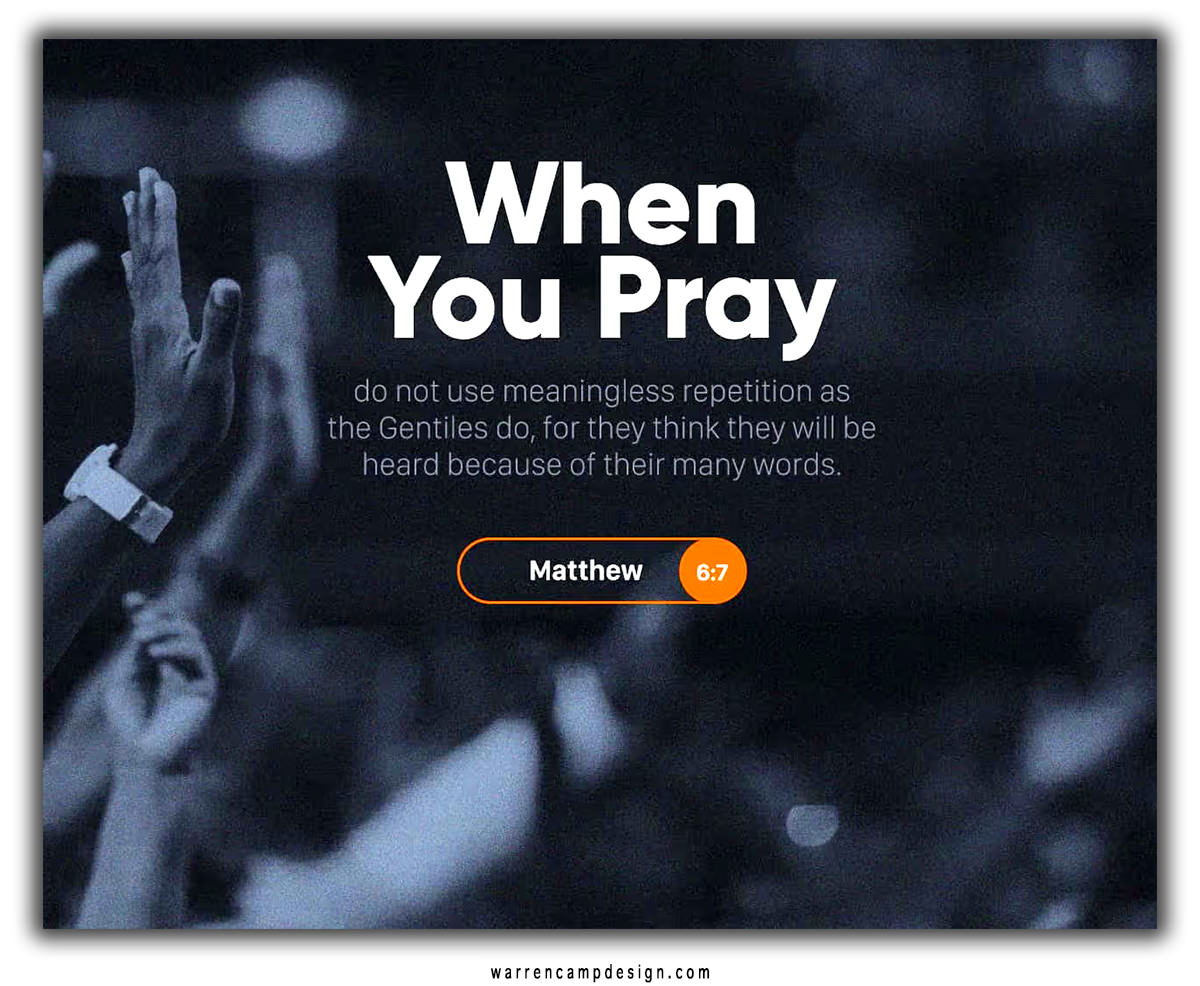
“And when you pray, do not keep on babbling like pagans, for they think they will be heard because of their many words. Do not be like them, for your Father knows what you need before you ask him” (vv. 7–8, NIV).
Click to enlarge and print:
Matthew 6:7
The Illusion of Mechanical Manipulation Jesus warns his disciples against “babbling” (“using vain repetitions” in some translations). In the ancient Greco-Roman and pagan religious worlds, people often believed that gods were fickle or detached, requiring long lists of names, endless repetition of sacred formulas, or hours of chanting to finally pay attention. Jesus rejects this entirely. Prayer isn’t a mechanical lever we pull, nor is it a chant designed to wear down a reluctant deity. When we treat prayer like a formula to be recited rather than a conversation to be entered, we act more like frantic pagans than trusting children.
The Comfort of a Knowing Father Verse 8 delivers one of the most liberating truths in the entire Sermon on the Mount: “for your Father knows what you need before you ask him.” This raises a natural and vital question for any praying person: If God already knows what we need, why pray at all? The answer changes our entire understanding of prayer. Prayer isn’t an informational briefing where we update an uninformed God on our current crisis; it’s a relational dialogue where we express our dependence. Because our Father already loves us and knows our struggles intimately, we don’t need to panic, perform, or pitch our prayers with eloquent salesmanship. We can come honestly, simply, and restfully into his presence.
Jesus isn’t forbidding all repeated prayers. He himself prayed repeated words in Gethsemane, and Scripture includes repeated cries of worship, lament, and praise. The problem isn’t persistence, repetition, or praying at length. The problem is empty, mindless, or manipulative speech — the belief that God can be pressured, impressed, or controlled by the number of words we say. A short, honest prayer spoken in faith is never inferior to a longer prayer offered with a sincere heart.
This truth can bring particular comfort to people who feel inadequate in prayer. You don’t need impressive vocabulary, polished sentences, or a carefully performed religious tone before God will listen. You can pray while grieving, confused, tired, afraid, thankful, or unsure. Sometimes prayer may be as simple as, “Father, help me,” “Lord, give me wisdom,” or “God, have mercy.” Your Father knows your need before you ask, yet he welcomes you to ask because prayer is one of the ways he draws you into trust, dependence, and fellowship with him.
The Blueprint for Kingdom Prayer (6:9–13)
Having stripped away in the preceding verses the performance of public showmanship and the frantic repetition of pagan ritual, Jesus now provides his disciples with a revolutionary model for communication with God. Often called the Lord’s Prayer, this concise template radically reorients our priorities, turning our attention away from self-centered demands while anchoring our hearts entirely in God’s holiness, rule, and daily provision.
“This, then, is how you should pray: ‘Our Father in heaven, hallowed be your name, your kingdom come, your will be done on earth as it is in heaven. Give us today our daily bread. Forgive us our debts, as we also have forgiven our debtors. And lead us not into temptation, but deliver us from the evil one’” (vv. 9–13, NIV).
The Relational Foundation and Godward Focus (Vv. 9–10) Jesus begins the prayer with two deeply reassuring words: “Our Father.” When Jesus teaches his disciples to pray this way, he invites them to come to God with the secure trust of beloved children. Yet “in heaven” immediately reminds us that our Father isn’t merely familiar or manageable; he’s the holy and sovereign ruler over all creation. The opening petitions are God-centered rather than self-centered. To pray, “hallowed be your name,” is to ask that God’s name — his character, reputation, and presence — be honored as holy in our lives and throughout the world. To pray, “your kingdom come” and “your will be done, on earth as it is in heaven,” is to submit our own priorities to God’s good rule and to long for his restoring purposes to be increasingly seen in the world.
Daily Dependence and Forgiving Grace (Vv. 11–12) After turning our attention toward God’s glory and kingdom, Jesus brings us to ordinary human need: “Give us today our daily bread.” This petition teaches humble, day-by-day dependence. It includes food and the practical necessities by which God sustains life. We’re not self-sufficient; every good provision ultimately comes from his hand. The prayer is also communal: Jesus teaches us to say “our” bread, reminding us to care about the needs of others as well as our own.
Jesus then teaches us to pray, “Forgive us our debts, as we also have forgiven our debtors.” In this context, “debts” refers to sins and moral obligations before God. We come to the Father not defending our failures, but confessing our need for mercy. At the same time, Jesus joins our receiving of forgiveness to our willingness to forgive those who sin against us. He isn’t teaching that we earn God’s grace by forgiving perfectly. Rather, a life that receives the Father’s mercy must increasingly become a life that extends mercy to others.
Protection in Testing and Evil (V. 13) The prayer concludes with a sober recognition of human weakness and spiritual danger: “And lead us not into temptation, but deliver us from the evil one.” This petition doesn’t imply that God tempts people to sin; James 1:13 clearly denies that. Instead, we ask the Father to guide us away from situations and paths in which we are especially vulnerable, to give us wisdom and strength when testing comes, and to rescue us from the power and deception of evil. The Lord’s Prayer transforms prayer from a self-centered checklist into a holistic rhythm of worship, surrender, dependence, confession, forgiveness, and trust.
The Non-Negotiable Link of Forgiveness (6:14–15)
Having just woven human forgiveness directly into the fabric of the Lord’s Prayer, Jesus pauses immediately after the prayer to underscore its absolute urgency. In vv. 14 and 15, he pulls out of the broader flow of instruction to ensure his listeners grasp a sobering, uncompromising reality: Vertical peace with God can’t coexist with horizontal bitterness toward others.
The Inseparable Twin Dynamics of Grace Jesus isolates the petition regarding debts and debtors from the Lord’s Prayer, explicitly repeating it to remove any ambiguity. He’s not teaching a legalistic formula where we earn God’s forgiveness by being nice enough to our enemies; Scripture is clear that God’s grace is a free gift. Instead, Jesus is revealing a spiritual law of nature: A heart that’s truly tasted and understood the staggering mercy of God is fundamentally incapable of withholding that same mercy from someone else. To accept God’s forgiveness while nursing an unforgiving, vengeful grudge against a neighbor is a profound contradiction in terms.
The Danger of an Unforgiving Heart The second half of v. 15 carries a stark and disruptive warning: “But if you do not forgive others their sins, your Father will not forgive your sins.” This language can make us uncomfortable, but Jesus uses it to jolt us out of cheap grace. Harboring deep-seated bitterness, refusing to release an offender, or weaponizing a grudge acts like a spiritual dam that chokes off our experience of God’s fellowship. When we shut our hearts to others, we effectively isolate ourselves from the very grace we claim to live by. True kingdom citizenship is marked not by perfection, but by a relentless, grace-driven willingness to extend the forgiveness we’ve so freely received.
Jesus’ words about forgiveness must be taught with both seriousness and compassion. Forgiving someone doesn’t mean saying that the harm they caused was insignificant. It doesn’t mean denying the truth, abandoning wise boundaries, refusing to report a crime, or returning to an unsafe relationship. A person who’s experienced abuse, violence, betrayal, or deep injustice may need time, safety, pastoral care, counseling, legal protection, and support from trustworthy people. Jesus never asks wounded people to call evil good or to make themselves available for further harm.
Jesus’ warning is strong because an unforgiving posture contradicts the mercy we continually ask to receive from God. His purpose isn’t to crush a repentant person who’s struggling to forgive, but to expose the spiritual danger of cherishing revenge and refusing mercy altogether. We can bring even our inability to forgive honestly to the Father: Lord: I’m hurt. I don’t want bitterness to rule me. Help me to release this person and to walk in the mercy you’ve shown me.
Practical Application of This Sermon Passage (6:5–15)
† Make a regular appointment with the Father. Choose a realistic time and place for private prayer this week. It may be ten quiet minutes in the morning, a walk, a parked car before heading our, or a few minutes before bed. The goal isn’t an impressive routine but a sincere habit of coming before God when no one else is watching.
† Pray simply and honestly. You don’t need polished religious language. Begin with the words Jesus gave us: Honor God’s name, ask for his kingdom and will, bring your daily needs, confess sin, forgive others, and ask for protection from temptation and evil.
† Use the Lord’s Prayer as a pattern, not merely a recital. Pray the words slowly, then pause after each petition. Ask: How can God’s name be honored in my life today? … Where do I need his will rather than my own? … What’s today’s “daily bread”? … Whom do I need to forgive? … Where do I need protection and wisdom?
† Take one step toward forgiveness. If someone has wronged you, bring the hurt truthfully before God. Release the desire for personal revenge, even if the process will take time. Seek wise boundaries, accountability, counseling, pastoral help, or legal protection when needed. Forgiveness doesn’t erase the need for truth and safety, but it refuses to let bitterness control the heart.
Conclusion
Matthew 6:5–15 calls us into a prayer life that’s sincere, simple, God-centered, and shaped by grace. Jesus frees us from the pressure to impress people with public spirituality and from trying to persuade God through empty or excessive words. Our Father already knows our needs, welcomes us into his presence, and teaches us to pray as his beloved children.
The Lord’s Prayer gives us a pattern for a whole life of dependence: honoring God’s name, longing for his kingdom, receiving daily provision, confessing sin, extending forgiveness, and seeking protection from temptation and evil. Prayer isn’t a religious performance or a tool for controlling outcomes. It’s the privilege of bringing our complete lives before the Father who sees in secret, knows what we need, and is shaping us into people who exhibit his mercy.
- Q. 1 In what setting are you most tempted to make prayer sound more spiritual, impressive, or polished than it really is? Can you pray with simple honesty with God?
- Q. 2 Which petition of the Lord’s Prayer most speaks to your present situation: God’s name, his kingdom and will, daily bread, forgiveness, protection from temptation and evil?
- Q. 3 Is there a person whose sin against you still produces resentment, anger, or a desire for payback? What would it mean to begin bringing that wound honestly to God while also maintaining any needed wise boundaries?
Are you ready to take Warren’s 25-question Sermon on the Mount quiz? Answers with Bible references are included with your grade.